I demand whether all wars, bloodshed and misery came not
upon the creation when one man endeavoured to be a lord over
another? ... And whether this misery shall not remove... when all
the branches of mankind shall look upon the earth as one
common treasury to all.
To him she was a fragmented commodity whose feelings and
choices were rarely considered: her head and her heart were
separated from her back and her hands and divided from her
womb and vagina. Her back and muscle were pressed into field
labor... her hands were demanded to nurse and nurture the white
man .... [H]er vagina, used for his sexual pleasure, the gateway
to the womb, which his place of capital investment - the capital
investment being the sex-act and the resulting child the
accumulated surplus....
>>
Albrecht Durer, The Fall of Man< (1510).
This powerful scene, on the expulsion of Adam and Eve from the
Garden of Eden, evokes the expulsion of the peasantry from its
common lands, which was starting to occur across western
Europe at the very time when Durer was producing this work.
Introduction
Footnotes 1 & 2
1. Peter Blickle objects to the concept of a “peasant war” because of the social composition of this revolution, which included many artisans, miners, and intellectuals
among its ranks. The Peasant War combined ideological sophistication, expressed
in the twelve articles’ which the rebels put forward, and a powerful military organization. The twelve articles included: the refusal of bondage, a reduction of the
tithes, a repeal of the poaching laws, an affirmation of the rights to gather wood, a
lessening of labor service^, a reduction of rents, an affirmation of the rights to use
the common, and an abolition of death taxes (Bickle 1985: 195-201). The exceptional military prowess demonstrated by the rebels depended in part on the participation of professional soldiers in the revolt, including the Landsknechte — the
famous Swiss soldiers who, at the time, were the elite mercenary troops in Europe.
The Landsknechte headed the peasant armies, putting their military expertise at
their service and, in various occasions, refused to move against the rebels. In one
case, they motivated their refusal by arguing that they too came from the peasantry
and that they depended on the peasants for their sustenance in times of peace. When
it was clear that they could not be trusted, the German princes mobilized the troops
of the Swabian League, drawn from more remote regions, to break the peasant
resistance. On the history of the Landsknechte and their participation in the Peasant
War, see Reinhard Baumann, I Lanzichenecchi (1994: 237-256).
2. The Anabaptists, politically, represented a fusion of "the late
medieval social movements and the new anti-clerical movement
sparked off by the Reformation." Like the medieval heretics, they
condemned economic individualism and greed and supported a
form of Christian communalism.Their take-over of Munster
occurred in the wake of the Peasant War, when unrest and urban
insurrections spread from Frankfurt to Cologne and other towns
of Northern Germany. In 1531, the crafts took control of the city
of Munster, renamed it New Jerusalem, and under the influence
of immigrant Dutch Anabaptists, installed in it a communal
government based upon the sharing of goods. As Po-Chia Hsia
writes, the records of New Jerusalem were destroyed and its
story has been told only by its enemies.Thus, we should not
presume that events unfolded as narrated. According to the
available records, women had at first enjoyed a high degree of
freedom in the town; for instance, "they could divorce their
unbelieving husbands and enter into new marriages." Things
changed with the decision by the reformed government to
introduce polygamy in 1534, which provoked an "active
resistance" among women, presumably repressed with
imprisonment and even executions (Po-Chia Hsia 1988a: 58-59).
Why this decision was taken is not clear. But the episode
deserves more investigation, given the divisive role that the
crafts played in the "transition" with regard to women. We know,
in fact, that the craft campaigned in several countries to exclude
women from the waged work-place, and nothing indicates that
they opposed the persecution of the witches.
The development of capitalism was not the only possible response to
the crisis of feudal power. Throughout Europe, vast communalistic
social movements and rebellions against feudalism had offered the
promise of a new egalitarian society built on social equality and
cooperation. However, by 1525 their most powerful expression, the
"Peasant War" in Germany or, as Peter Blickle called it, the
"revolution of the common man," was rushed.1
A hundred thousand
rebels were massacred in retaliation. Then, in 1535, "New
Jerusalem," the attempt made by the Anabaptists in the town of
Munster to bring the kingdom of God to earth, also ended in a
bloodbath, first undermined presumably by the patriarchal turn taken
by its leaders who, by imposing polygamy, caused the women
among their ranks to revolt.2
With these defeats, compounded by
the spreads of hunts and the effects of colonial expansion, the
revolutionary process in Europe came to an end. Military might was
not sufficient, however, to avert the crisis of feudalism.
By the late Middle Ages the feudal economy was doomed, faced with
an accumulation crisis that stretched for more than a century. We
deduce its dimension from some basic estimates indicating that
between 1350 and 1500 a major shift occurred in the power-relation
between workers and masters. The real wage increased by 100%,
prices declined by 33%, rents also declined, the length of the
working-day decreased, a tendency appeared toward local self-
sufficiency3.
3. For the rise of the real wage and the fall of prices in England,
see North and Thomas (1973:74). For Florentine wages, see
Carlo M. Cipolla (1994: 206). For the fall in the value of output in
England see R. H. Britnel (1993:156-171). On the stagnation of
agricultural production in a number of European countries, see
B.H. SlicherVan Bath (1963:160-170). Rodney Hilton argues that
this period saw "a contraction of the rural and industrial
economies...probably felt in the first place by the ruling
class....Seigneurial revenues and industrial and commercial
profits began to fall....Revolt in the towns disorganized industrial
production and revolt in the countryside strengthened peasant
resistance to the payment of rent. Rent and profits thus dropped
even further" (Hilton 1985:240-241).
Evidence of a chronic disaccumulation trend in this period is also found in the pessimism of the contemporary merchants and landowners, and the measures which the European states
adopted to protect rackets, suppress competition and force people to
work at the conditions imposed. As the entries in the registers of the
feudal manors recorded, "the work [was] not worth the breakfast"
(Dobb 1963: 54). The feudal economy could not reproduce itself, nor
could a capitalist society have "evolved" from it, for self-sufficiency
and the new high-wage regime allowed for the "wealth of the
people," but "excluded the possibility of capitalistic wealth" (Marx
1909, Vol.I: 789).
It was in response to this crisis that the European ruling class
launched the global offensive that in the course of at least three
centuries was to change the history of the planet, laying the
foundations of a capitalist world-system, in the relentless attempt to
appropriate new sources of wealth, expand its economic basis, and
bring new workers under its command.
5. Critics of Marx's concept of "primitive accumulation" include:
Samir Amin (1974) and Maria Mies (1986). While Samir Amin
focusses on Marx's Eurocentrism, Mies stresses Marx's
blindness to the exploitation of women. A different critique is
found in Yann Moulier Boutang (1998) who faults Marx for
generating the impression that the objective of the ruling class in
Europe was to free itself from an unwanted work-force. Moulier
Boutang underlines that the opposite was the case: land
expropriation aimed to fix workers to their jobs, not to encourage
mobility. Capitalism — as Moulier Boutang stresses — has
always been primarily concerned with preventing the flight of
labor (pp. 16—27).
As we know, "conquest, enslavement, robbery, murder, in brief force"
were the pillars of this process (ibid.: 785). Thus, the concept of a
"transition to capitalism" is in many ways a fiction. British historians,
in the 1940s and 1950s, used it to define a period — roughly from
1450 to 1650 — in which feudalism in Europe was breaking down
while no new social-economic system was yet in place, though
elements of a capitalist society were taking shape. The concept of
"transition," then, helps us to think of a prolonged process of change
and of societies in which capitalist accumulation coexisted with
political formations not yet predominantly capitalistic. The term,
however, suggests a gradual, linear historical development, whereas
the period it names was among the bloodiest and most
discontinuous in world history — one that saw apocalyptic
transformation and which historians can only describe in the
harshest terms: the Iron Age (Kamen), the Age of Plunder (Hoskins),
and the Age of the Whip (Stone). "Transition," then, cannot evoke
the changes that paved the way to the advent of capitalism and the
forces that shaped them. In this volume, therefore, I use the term
primarily in a temporal sense while I refer to the social processes
that characterized the "feudal reaction" and the development of
capitalist relations with the Marxian concept of "primitive
accumulation," though I agree with its critics that we must rethink
Marx's interpretation of it.5
Footnotes 6 & 7
6. As Michael Perelman points out, the term "primitive
accumulation" was actually coined by Adam Smith and rejected
by Marx, because of its ahistorical character in Smith's usage.
"To underscore his distance from Smith, Marx prefixed the
pejorative ‘so-called' to the title of the final part of the first volume
of Capital, which he devoted to the study of primitive
accumulation. Marx, in essence, dismissed Smith's mythical
‘previous' accumulation in order to call attention to the actual
historical experience" (Perlman 1985:25-26).
7. On the relation between the historical and the logical
dimension of "primitive accumulation" and its implications for
political movements today see: Massimo De Angelis, "Marx and
Primitive Accumulation. The Continuous Character of Capital
‘Enclosures'." In The Commoner: www.commoner.org.uk; Fredy
Perlman, The Continuing Appeal of Nationalism. Detroit: Black
and Red, 1985; and Mitchel Cohen, "Fredy Perlman: Out in Front
of a Dozen Dead Oceans" (Unpublished manuscript, 1998).
Marx introduced the concept of "primitive accumulation" at the end of
Capital Volume I to describe the social and economic restructuring
that the European ruling class initiated in response to its
accumulation crisis, and to establish (in polemics with Adam Smith)6
that: (i) capitalism could not have developed without a prior
concentration of capital and labor; and that (ii) the divorcing of the
workers from the means of production, not abstinence of the rich, is
the source of capitalist wealth. Primitive accumulation, then, is useful
concept, for it connects the "feudal reaction" with the development of
a capitalist economy and it identifies the historical and logical
conditions for the development of the capitalist system, "primitive"
("originary") indicating a precondition for the existence of capitalist
relations as much as a specific event in time.7
Marx, however, analyzed primitive accumulation almost exclusively
from the viewpoint of the waged industrial proletariat: the
protagonist, in his view, of the revolutionary process of his time and
the foundation for the future communist society. Thus, in his account,
primitive accumulation consists essentially in the expropriation of the
land from the European peasantry and the formation of the "free,"
independent worker, although he acknowledged that:
The discovery of gold and silver in America, the extirpation,
enslavement and entombment in mines of the aboriginal
population, [of America], the beginning of the conquest and
looting of the East Indies, the turning of Africa into a preserve for
the commercial hunting of black skins, are ... the chief moments
of primitive accumulation ... (Marx 1909, Vol. I: 823).
Marx also recognized that "[a] great deal of capital, which today
appears in the United States without any certificate of birth, was
yesterday in England the capitalised blood of children" (ibid.: 820-
30). By contrast, we do not find in his work any mention of the
profound transformations that capitalism introduced in the
reproduction of labor-power and the social position of women. Nor
does Marx's analysis of primitive accumulation mention the "Great
Witch-Hunt" of the 16th and 17th centuries, although this state-
sponsored terror campaign was central to the defeat of the European
peasantry, facilitating its expulsion from the lands it once held in
common.
In this chapter and those that follow, I discuss these developments,
especially with reference to Europe, arguing that:
- The expropriation of European workers from their means of
subsistence, and the enslavement of Native Americans and
Africans to the mines and plantations of the "New World," were
not the only means by which a world proletariat was formed and
"accumulated."
- This process required the transformation of the body into a
work-machine, and the subjugation of women to the
reproduction of the work-force. Most of all, it required the
destruction of the power of women which, in Europe as in
America, was achieved through the extermination of the
"witches."
- Primitive accumulation, then, was not simply an accumulation
and concentration of exploitable workers and capital. It was also
an accumulation of differences and divisions within the working
class, whereby hierarchies built upon gender, as well as "race"
and age, became constitutive of class rule and the formation of
the modern proletariat.
- We cannot, therefore, identify capitalist accumulation with the
liberation of the worker, female or male, as many Marxists
(among others) have done, or see the advent of capitalism as a
moment of historical progress. On the contrary, capitalism has
created more brutal and insidious forms of enslavement, as it
has planted into the body of the proletariat deep divisions that
have served to intensify and conceal exploitation. It is in great
part because of these imposed divisions — especially those
between women and men — that capitalist accumulation
continues to devastate life in every corner of the planet.
Capitalist Accumulation and the Accumulation of
Labor in Europe
Footnotes 8 & 9
8. For a description of the systems of the encomienda, mita, and
catequil see (among others) Andre Gunder Frank (1978),45;
Steve J. Stern (1982); and Inga Clendinnen (1987). As described
by Gunder Frank, the encomienda. was "a system under which
rights to the labor of the Indian communities were granted to
Spanish landowners." But in 1548, the Spaniards "began to
replace the encomienda de servido by the repartimiento (called
catequil in Mexico and mita in Peru), which required the Indian
community's chiefs to supply the Spanish juez repartidor
(distributing judge) with a certain number of days of labor per
month.... The Spanish official in turn distributed this supply of
labor to qualified enterprising labor contractors who were
supposed to pay the laborers a certain minimum wage"
(1978:45). On the efforts of the Spaniards to bind labor in Mexico
and Peru in the course of the various stages of colonization, and
the impact on it of the catastrophic collapse of the indigenous
population, see again Gunder Frank (ibid.: 43-49). ↩
9. For a discussion of the "second serfdom" see Immanuel
Wallerstein (1974) and Henry Kamen (1971). It is important here
to stress that the newly enserfed peasants were now producing
for the international grain market. In other words, despite the
seeming backward character of the work-relation imposed upon
them, under the new regime, they were an integral part of a
developing capitalist economy and international capitalist division
of labor.
Capital, Marx wrote, comes on the face of the earth dripping blood
and dirt from head to toe (1909, Vol. I: 834) and, indeed, when we
look at the beginning of capitalist development, we have the
impression of being in an immense concentration camp. In the "New
World" we have the subjugation of the aboriginal population to the
regimes of the mita and cuatelchil8 under which multitudes of people
were consumed to bring silver and mercury to the surface in the
mines of Huancavelica and Potosi. In Eastern Europe, we have a
"second serfdom," tying to the land a population of farmers who had
I never previously been enserfed.9 In Western Europe, we have the
Enclosures, the Witch Hunt, the branding, whipping, and
incarceration of vagabonds and beggars in newly constructed work-
houses and correction houses, models for the future prison system.
On the horizon, we have the rise of the slave trade, while on the
seas, ships are already transporting indentured servants and
convicts from Europe to America.
10.I am echoing here Marx's statement in Capital, Vol. 1:
"Force... is in itself an economic power" (1909: 824). Far less
convincing is Marx's accompanying observation, according to
which: "Force is the midwife of every old society pregnant with a
new one" (ibid.). First, midwives bring life into the world, not
destruction. This metaphor also suggests that capitalism
"evolved" out of forces gestating in the bosom of the feudal world
— an assumption which Marx himself refutes in his discussion of
primitive accumulation. Comparing force to the generative
powers of a midwife also casts a benign veil over the process of
capital accumulation, suggesting necessity, inevitability, and
ultimately, progress.
What we deduce from this scenario is that force was the main lever,
the main economic power in the process of primitive accumulation10
because capitalist development required an immense leap in the
wealth appropriated by the European ruling class and the number of
workers brought under its command. In other words, primitive
accumulation consisted in an immense accumulation of labor-power
— "dead labor" in the form of stolen goods, and "living labor" in the
form of human beings made available for exploitation — realized on
a scale never before matched in the course of history.
Significantly, the tendency of the capitalist class, during the first three
centuries of its existence, was to impose slavery and other forms of
coerced labor as the dominant work relation, a tendency limited only
by the workers' resistance and the danger of the exhaustion of the
work-force.
11. Slavery had never been abolished in Europe, surviving in
pockets, mostly as female domestic slavery. But by the end of
the 15th century slaves began to be imported again, by the
Portuguese, from Africa. Attempts to impose slavery continued in
England through the 16th century, resulting (after the introduction
of public relief) in the construction of work-houses and correction
houses, which England pioneered in Europe.
This was true not only in the American colonies, where, by the 16th
century, economies based on coerced labor were forming, but in
Europe as well. Later, I examine the importance of slave-labor and
the plantation system in capitalist accumulation. Here I want to
stress that in Europe, too, in the 15th century, slavery, never
completely abolished, was revitalized.11
As reported by the Italian historian Salvatore Bono, to whom we owe
the most extensive study of slavery in Italy, there were numerous
slaves in the Mediterranean areas in the 16th and 17th centuries,
and their numbers grew after the Battle of Lepanto (1571) that
escalated the hostilities against the Muslim world. Bono calculates
that more than 10,000 slaves lived in Naples and 25,000 in the
Napolitan kingdom as a whole (one per cent of the population), and
similar figures apply to other Italian towns and to southern France. In
Italy, a system of public slavery developed whereby thousands of
kidnapped foreigners — the ancestors of today's undocumented
immigrant workers — were employed by city governments for public
works, or were farmed out to private citizens who employed them in
agriculture. Many were destined for the oars, an important source of
such employment being the Vatican fleet (Bono 1999:6-8).
Footnotes 12 to 16
12. See, on this point, Samir Amin (1974). To stress the
existence of European slavery in the 16th and 17th centuries
(and after) is also important because this fact has been often
"forgotten" by European historians. According to Salvatore Bono,
this self-induced oblivion was a product of the "Scramble for
Africa," which was justified as a mission aimed to terminate
slavery on the African continent. Bono argues that Europe's
elites could not admit to having employed slaves in Europe, the
alleged cradle of democracy.
13. Immanuel Wallerstein (1974), 90-95; Peter Kriedte (1978),
69-70.
14. Paolo Thea (1998) has powerfully reconstructed the history
of the German artists who sided with the peasants.
During the Protestant Reformation some among the best 16th-century
German artists abandoned their laboratories to join the peasants in struggle....
They drafted documents inspired by the principles of evangelic poverty, the common sharing of goods, and the redistribution of wealth. Sometimes... they took
arms in support of the cause.The endless list of those who, after the military defeats
of May-June 1525, met the rigors of the penal code, mercilessly applied by the
winners against the vanquished, includes famous names. Among them are [Jorg]
Ratget quartered in Pforzheim (Stuttgart), [Philipp] Dietman beheaded, and
[Tilman] Riemenschneider mutilated — both in Wurzburg — [Matthias]
Grunewald chased from the court of Magonza where he worked. Holbein the
Young was so troubled by the events that he fled from Basel, a city that was torn
apart by religious conflict.” [My translation]
Also in Switzerland, Austria, and the Tyrol artists participated in the Peasant War, including famous ones like Lucas Cranach (Cranach the old) as well as myriad lesser painters and engravers (ibid.: 7). Thea points out that the deeply felt participation of the artists to the cause of the peasants is also demonstrated by the revaluation of rural themes depicting peasant life — dancing peasants, animals, and flora — in contemporary 16th-century German art (ibid.:12-15; 73,79,80).“The countryside had become animated... [it] had acquired in the uprising a personality worth of being represented” (ibid.: 155). [My translation],
15. It was through the prism of the Peasant War and Anabaptism
that the European governments, through the 16th and 17th
centuries, interpreted and repressed every form of social protest.
The echoes of the Anabaptist revolution were felt in Elizabethan
England and in France, inspiring utmost vigilance and severity
with regard to any challenge to the constituted authority.
"Anabaptist" became a cursed word, a sign of opprobrium and
criminal intent, as "communist" was in the United States in the
1950s, and "terrorist" is today.
16. Village authority and privileges were maintained in the
hinterland of some city-states. In a number of territorial states,
the peasants "continued to refuse dues, taxes, and labor
services"; "they let me yell and give me nothing," complained the
abbot of Schussenried, referring to those working on his land
(Blickle 1985: 172). In Upper Swabia (southwest Germany),
though serfdom was not abolished, some of the main peasant
grievances relating to inheritance and marriage rights were
accepted with the Treaty of Memmingen of 1526. “On the Upper
Rhine, too, some areas reached setdements that were positive
for the peasants” (ibid.:172-174). In Switzerland, in Bern and
Zurich, serfdom was abolished. Improvements in the lot of the
“common man” were negotiated in Tyrol and Salzburg (ibid.: 176-
179). But “the true child of the revolution” was the territorial
assembly, instituted after 1525 in Upper Swabia, providing the
foundation for a system of self-government that remained in
place till the 19th century. New territorial assemblies emerged
after 1525 “[realizing] in a weakened form one of the demands of
1525: that the of common man ought to be part of the territorial
estates alongside the nobles, the clergy, and the towns." Blickle
concludes that “Wherever this cause won out, we cannot say
that there the lords crowned their military conquest with political
victory, [as] the prince was still bound to the consent of the
common man. Only later, during the formation of the absolute
state, did the prince succeed in freeing himself from that
consent”(ibid.: 181-182).
Slavery is "that form [of exploitation] towards which the master
always strives" (Dockes 1982: 2). Europe was no exception. This
must be emphasized to dispel the assumption of a special
connection between slavery and Africa.12 But in Europe slavery
remained a limited phenomenon, as the material conditions for it did
not exist, although the employers' desires for it must have been quite
strong if it took until the 18th century before slavery was outlawed in
England. The attempt to bring back serfdom failed as well, except in
the East, where population scarcity gave landlords the upper
hand.13 In the West its restoration was prevented by peasant
resistance culminating in the "German Peasant War." A broad
organizational effort spreading over three countries (Germany,
Austria, Switzerland) and joining workers from every field (farmers,
miners, artisans, including the best German and Austrian artists),14
this "revolution of the common man" was a watershed in European
history. Like the 1917 Bolshevik Revolution in Russia, it shook the
powerful to the core, merging in their consciousness with the
Anabaptists takeover of Munster, which confirmed their fears that an
international conspiracy was underway to overthrow their power.15
After its defeat, which occurred in the same year as the conquest of
Peru, and which was commemorated by Albrecht Differ with the
"Monument to the Vanquished Peasants" (Thea 1998:65; 134-35),
the revenge was merciless. "Thousands of corpses laid on the
ground from Thuringia to Alsace, in the fields, in the woods, in the
ditches of a thousand dismantled, burned castles," "murdered,
tortured, impaled, martyred" (ibid.: 153,146). But the clock could not
be turned back. In various parts of Germany and the other territories
that had been at the center of the "war," customary rights and even
forms of territorial government were preserved.16
Footnotes 17 & 18
17. Referring to the growing pauperization brought about across
the world by capitalist development, the French anthropologist
Claude Meillassoux, in Maidens, Meal and Money (1981), has
argued that this contradiction spells a future crisis for capitalism:
“In the end imperialism — as a means of reproducing cheap
labor power — is leading capitalism to a major crisis, for even if
there are still millions of people in the world... not directly
involved in capitalist employment... how many are still capable
owing to the social disruption, famine and wars it brings about, of
producing their own subsistence and feeding their children?”
(1981:140).
18. The extent of the demographic catastrophe caused by “the
Columbian Exchange” is still debated. Estimates of the
population decline in South and Central America, in the first post-Columbian century, range widely, but contemporary scholarly
opinion is almost unanimous in likening its effects to an American
Holocaust. Andre Gunder Frank writes that: “Within little more
than a century, the Indian population declined by ninety percent
and even ninety-five percent in Mexico, Peru, and some other
regions” (1978: 43). Similarly, Noble David Cook argues that:
“Perhaps 9 million people resided within the limits delineated by
Peru’s contemporary boundaries.The number of inhabitants
remaining a century after contact was roughly a tenth of those
that were there when the Europeans invaded the Andean world”
(Cook 1981:116).
This was an exception. Where workers' resistance to re-enserfment
could not be broken, the response was the expropriation of the
peasantry from its land and the introduction of forced wage-labor.
Workers attempting to hire themselves out independently or leave
their employers were punished with incarceration and even with
death, in the case of recidivism. A "free" wage labor-market did not
develop in Europe until the 18th century, and even then, contractual
wage-work was obtained only at the price of an intense struggle and
by a limited set of laborers, mostly male and adult. Nevertheless, the
fact that slavery and serfdom could not be restored meant that the
labor crisis that had characterized the late Middle Ages continued in
Europe into the 17th century, aggravated by the fact that the drive to
maximize the exploitation of labor put in jeopardy the reproduction of
the work-force. This contradiction — which still characterizes
capitalist development17 — exploded most dramatically in the
American colonies, where work, disease, and disciplinary
punishments destroyed two thirds of the native American population
in the decades immediately after the Conquest.18 It was also at the
core of the slave trade and the exploitation of slave labor. Millions of
Africans died because of the torturous living conditions to which they
were subjected during the Middle Passage and on the plantations.
Never in Europe did the exploitation of the work-force reach such
genocidal proportions, except under the Nazi regime. Even so, there
too, in the 16th and 17th centuries, land privatization and the
commodification of social relations (the response of lords and
merchants to their economic crisis) caused widespread poverty,
mortality, and an intense resistance that threatened to shipwreck the
emerging capitalist economy. This, I argue, is the historical context in
which the history of women and reproduction in the transition from
feudalism to capitalism must be placed; for the changes which the
advent of Capitalism introduced in the social position of women —
especially at the proletarian level, whether in Europe or America —
were primarily dictated by the search for new sources of labor as
well as new forms of regimentation and division of the work-force.
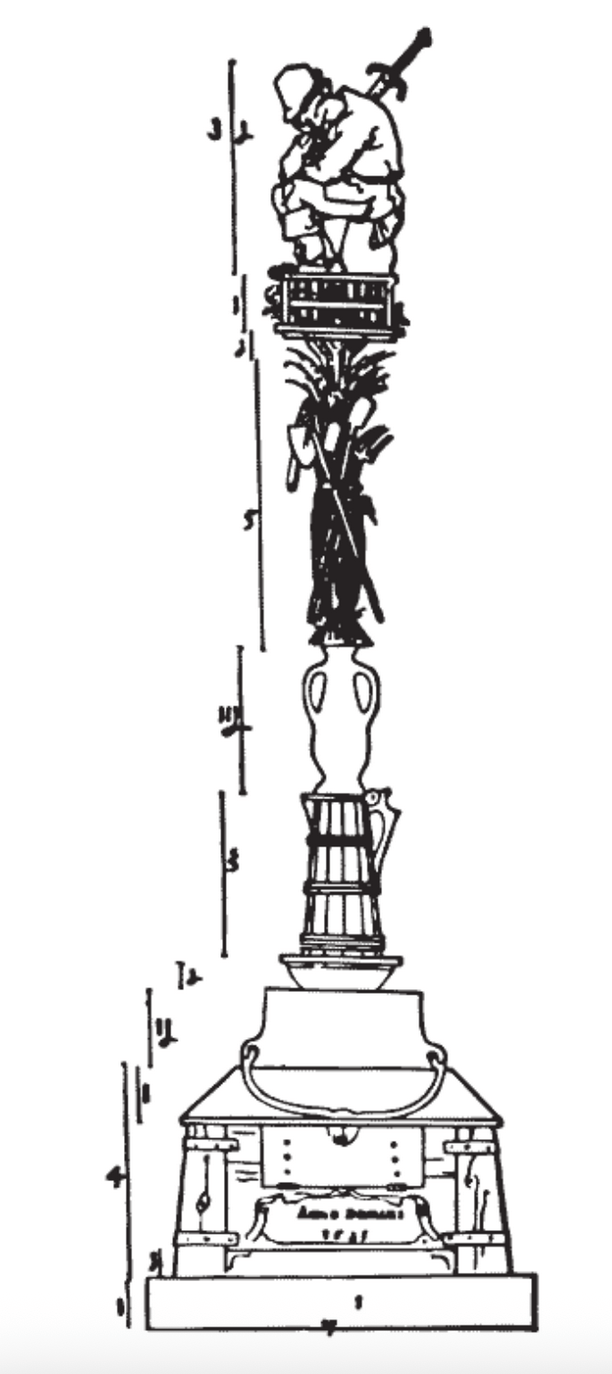 Albrect Durer, Monument to the Vanquished Peasants. (1526).
This picture, representing a peasant enthroned on a collection of
objects from his daily life, is highly ambigious. It can suggest that
the peasants were betrayed or that they themslves should be
treated as traitors. Accordingly, it has been interpreted either as
a satire of the rebel peasants or as a homage to their moral
strength. What we know with certainty is that Durer was
profoundly perturbed by the events of 1525, and, as a convinced
Lutheran, must have followed Luther in his condemnation of the
revolt.
Albrect Durer, Monument to the Vanquished Peasants. (1526).
This picture, representing a peasant enthroned on a collection of
objects from his daily life, is highly ambigious. It can suggest that
the peasants were betrayed or that they themslves should be
treated as traitors. Accordingly, it has been interpreted either as
a satire of the rebel peasants or as a homage to their moral
strength. What we know with certainty is that Durer was
profoundly perturbed by the events of 1525, and, as a convinced
Lutheran, must have followed Luther in his condemnation of the
revolt.
In support of this statement, I trace the main developments that
shaped the advent of capitalism in Europe — land privatization and
the Price Revolution — to argue that neither was sufficient to
produce a self-sustaining process of proletarianization. I then
examine in broad outlines the policies which the capitalist class
introduced to discipline, reproduce, and expand the European
proletariat, beginning with the attack it launched on women, resulting
in the construction of a new patriarchal order, which I define as the
"patriarchy of the wage." Lastly, I look at the production of racial and
sexual hierarchies in the colonies, asking to what extent they could
form a terrain of confrontation or solidarity between indigenous,
African, and European women and between women and men.
Land Privatisation in Europe, the Production of
Scarcity, and the Separation of Production from
Reproduction
From the beginning of capitalism, the immiseration of the working
class began with war and land privatization.This was an international
phenomenon. By the mid-16th century European merchants had
expropriated much of the land of the Canary Islands and turned them
into sugar plantations. The most massive process of land
privatization and enclosure occurred in the Americas where, by the
turn of the 17th century, one-third of the communal indigenous land
had been appropriated by the Spaniards under the system of the
encomienda. Loss of land was also one of the consequences of
slave-raiding in Africa, which deprived many communities of the best
among their youth.
In Europe land privatization began in the late-15th century,
simultaneously with colonial expansion. It took different forms: the
evictions of tenants, rent increases, and increased state taxation,
leading to debt and the sale of land. I define all these forms as land
expropriation because, even when force was not used, the loss of
land occurred against the individual's or the community's will and
undermined their capacity for subsistence. Two forms of land
expropriation must be mentioned: war — whose character changed
in this period, being used as a means to transform territorial and
economic arrangements — and religious reform.
"[B]efore 1494 warfare in Europe had mainly consisted of minor wars
characterized by brief and irregular campaigns" (Cunningham and
Grell 2000: 95). These often took place in the summer to give the
peasants, who formed the bulk of the armies, the time to sow their
crops; armies confronted each other for long periods of time without
much action. But by the 16th century wars became more frequent
and a new type of warfare appeared, in part because of
technological innovation but mostly because the European states
began to turn to territorial conquest to resolve their economic crisis
and wealthy financiers invested in it. Military campaigns became
much longer. Armies grew tenfold, and they became permanent and
professionalized. Mercenaries were hired who had no attachment
to the local population; and the goal of warfare became the
elimination of the enemy, so that war left in its wake deserted
villages, fields covered with corpses, famines, and epidemics, as in
Albrecht Differs "The Four Horsemen of the Apocalypse" (1498).
This phenomenon, whose traumatic impact on the population is
reflected in numerous artistic representations, changed the
agricultural landscape of Europe.
19
20
Jaques Callot, The Horros of War (1633), Engraving. The men
hanged by military authorities were former soldiers turned
robbers. Dismissed soldiers were a large part of the vagabonds
and beggars that crowded the roads of 17th-century Europe.
Many tenure contracts were also annulled when the Church's lands
were confiscated in the course of the Protestant Reformation, which
began with a massive land-grab by the upper class. In France, a
common hunger for the Church's land at first united the lower and
higher classes in the Protestant movement, but when the land was
auctioned, starting in 1563, the artisans and day-laborers, who had
demanded the expropriation of the Church "with a passion born of
bitterness and hope," and had mobilized with the promise that they
too would receive their share, were betrayed in their expectations
(Le Roy Ladurie 1974:173—76). Also the peasants, who had
become Protestant to free themselves from the tithes, were
deceived. When they stood by their rights, declaring that "the Gospel
promises land freedom and enfranchisement," they were savagely
attacked as fomenters of sedition (ibid.: 192). In England as well,
much land changed hands in the name of religious reform. W. G.
Hoskin has described it as "the greatest transference of land in
English history since the Norman Conquest" or, more succinctly, as
"The Great Plunder." In England, however, land privatization was
mostly accomplished through the "Enclosures," a phenomenon that
has become so associated with the expropriation of workers from
their "common wealth" that, in our time, it is used by anti-capitalist
activists as a signifier for every attack on social entitlements.
21
22
23
In the 16th century, "enclosure" was a technical term, indicating a set
of strategies the English lords and rich farmers used to eliminate
communal land property and expand their holdings. It mostly
referred to the abolition of the open-field system, an arrangement by
which villagers owned non-contiguous strips of land in a non-hedged
field. Enclosing also included the fencing off of the commons and the
pulling down of the shacks of poor cottagers who had no land but
could survive because they had access to customary rights. Large
tracts of land were also enclosed to create deer parks, while entire
villages were cast down, to be laid to pasture.
Though the Enclosures continued into the 18th century (Neeson
1993), even before the Reformation, more than two thousand rural
communities were destroyed in this way (Fryde 1996:185). So
severe was the extinction of rural villages that in 1518 and again in
1548 the Crown called for an investigation. But despite the
appointment of several royal commissions, little was done to stop the
trend. What began, instead, was an intense struggle, climaxing in
numerous uprisings, accompanied by a long debate on the merits
and demerits of land privatization which is still continuing today,
revitalized by the World Bank's assault on the last planetary
commons.
Briefly put, the argument proposed by "modernizers," from all
political perspectives, is that the enclosures boosted agricultural
efficiency, and the dislocations they produced were well
compensated by a significant increase in agricultural productivity. It
is claimed that the land was depleted and, if it had remained in the
24
25
hands of the poor, it would have ceased to produce (anticipating
Garret Hardin's "tragedy of the commons") , while its takeover by
the rich allowed it to rest. Coupled with agricultural innovation, the
argument goes, the enclosures made the land more productive,
leading to the expansion of the food supply. From this viewpoint, any
praise for communal land tenure is dismissed as "nostalgia for the
past," the assumption being that agricultural communalism is
backward and inefficient, and that those who defend it are guilty of
an undue attachment to tradition.
But these arguments do not hold. Land privatization and the
commercialization of agriculture did not increase the food supply
available to the common people, though more food was made
available for the market and for export. For workers they inaugurated
two centuries of starvation, in the same way as today, even in the
most fertile areas of Africa, Asia, and Latin America, malnutrition is
rampant due to the destruction of communal land-tenure and the
"export or perish" policy imposed by the World Bank's structural
adjustment programs. Nor did the introduction of new agricultural
techniques in England compensate for this loss. On the contrary, the
development of agrarian capitalism "worked hand in glove" with the
impoverishment of the rural population (Lis and Soly 1979: 102). A
testimony to the misery produced by land privatization is the fact
that, barely a century after the emergence of agrarian capitalism,
sixty European towns had instituted some form of social assistance
or were moving in this direction, and vagabondage had become an
international problem (ibid.: 87). Population growth may have been a
26
27
contributing factor; but its importance has been overstated, and
should be circumscribed in time. By the last part of the 16th century,
almost everywhere in Europe, the population was stagnating or
declining, but this time workers did not derive any benefit from the
change.
There are also misconceptions about the effectiveness of the open-
field system of agriculture. Neo-liberal historians have described it as
wasteful, but even a supporter of land privatization like Jean De
Vries recognizes that the communal use of agricultural fields had
many advantages. It protected the peasants from harvest failure, due
to the variety of strips to which a family had access; it also allowed
for a manageable work-schedule (since each strip required attention
at a different time); and it encouraged a democratic way of life, built
on self-government and self-reliance, since all decisions — when to
plant or harvest, when to drain the fens, how many animals to allow
on the commons — were taken by peasant assemblies.28
Rural feast. All the festivals, games, and gatherings of the
peasant community were held on the commons. 16th-century
engravings by Daniel Hopfer.
The same considerations apply to the "commons." Disparaged in
16th century literature as a source of laziness and disorder, the
commons were essential to the reproduction of many small farmers
or cottars who survived only because they had access to meadows
in which to keep cows, or woods in which to gather timber, wild
berries and herbs, or quarries, fish-ponds, and open spaces in which
to meet. Beside encouraging collective decision-making and work
cooperation, the commons were the material foundation upon which
peasant solidarity and sociality could thrive. All the festivals, games,
and gatherings of the peasant community were held on the
commons. The social function of the commons was especially
important for women, who, having less title to land and less social
power, were more dependent on them for their subsistence,
autonomy, and sociality. Paraphrasing Alice Clark's statement about
the importance of markets for women in pre-capitalist Europe, we
can say that the commons too were for women the center of social
life, the place where they convened, exchanged news, took advice,
and where a women's viewpoint on communal events, autonomous
from that of men, could form (Clark 1968:51).
This web of cooperative relations, which R.D.Tawney has referred to
as the "primitive communism" of the feudal village, crumbled when
the open-field system was abolished and the communal lands were
fenced off (Tawney 1967). Not only did cooperation in agricultural
labor die when land was privatized and individual labor contracts
replaced collective ones; economic differences among the rural
population deepened, as the number of poor squatters increased
who had nothing left but a cot and a cow, and no choice but to go
with "bended knee and cap in hand" to beg for a job (Seccombe
1992). Social cohesion broke down; families disintegrated, the
youth left the village to join the increasing number of vagabonds or
29
30
itinerant workers — soon to become the social problem of the age —
while the elderly were left behind to fend for themselves. Particularly
disadvantaged were older women who, no longer supported by their
children, fell onto the poor rolls or survived by borrowing, petty theft,
and delayed payments .The outcome was a peasantry polarized not
only by the deepening economic inequalities, but by a web of hatred
and resentments that is well-documented in the records of the witch-
hunt, which show that quarrels relating to requests for help, the
trespassing of animals, or unpaid rents were in the background of
many accusations.
The enclosures also undermined the economic situation of the
artisans. In the same way in which multinational corporations take
advantage of the peasants expropriated from their lands by the
World Bank to construct "free export zones" where commodities are
produced at the lowest cost, so, in the 16th and 17th centuries,
merchant capitalists took advantage of the cheap labor-force that
had been made available in the rural areas to break the power of the
urban guilds and destroy the artisans' independence.This was
especially the case in the textile industry that was reorganized as a
rural cottage industry, and on the basis of the "putting out" system,
the ancestor of today's "informal economy," also built on the labor of
women and children. But textile workers were not the only ones
whose labor was cheapened. As soon as they lost access to land, all
workers were plunged into a dependence unknown in medieval
times, as their landless condition gave employers the power to cut
31
32
their pay and lengthen the working-day. In Protestant areas this
happened under the guise of religious reform, which doubled the
work-year by eliminating the saints' days.
Not surprisingly, with land expropriation came a change in the
workers' attitude towards the wage. While in the Middle Ages wages
could be viewed as an instrument of freedom (in contrast to the
compulsion of the labor services), as soon as access to land came to
an end wages began to be viewed as instruments of enslavement
(Hill 1975:181ff) .
Such was the hatred that workers felt for waged labor that Gerrard
Winstanley, the leader of the Diggers, declared that it that it did not
make any difference whether one lived under the enemy or under
one's brother, if one worked for a wage.This explains the growth, in
the wake of the enclosures (using the term in a broad sense to
include all forms of land privatization), of the number of "vagabonds"
and "masterless" men, who preferred to take to the road and to risk
enslavement or death — as prescribed by the "bloody" legislation
passed against them —rather than to work for a wage. It also
explains the strenuous struggle which peasants made to defend their
land from expropriation, no matter how meager its size.
In England, anti-enclosure struggles began in the late 15th century
and continued throughout the 16th and 17th, when leveling the
enclosing hedges became "the most common species of social
protest" and the symbol of class conflict (Manning 1988:311). Anti-
enclosure riots often turned into mass uprisings. The most notorious
33
34
was Kett's Rebellion, named after its leader, Robert Kett, that took
place in Norfolk in 1549.This was no small nocturnal affair. At its
peak, the rebels numbered 16,000, had an artillery, defeated a
government army of 12,000, and even captured Norwich, at the time
the second largest city in England. They also drafted a program
that, if realized, would have checked the advance of agrarian
capitalism and eliminated all vestiges of feudal power in the country.
It consisted of twenty-nine demands that Kett, a farmer and tanner,
presented to the Lord Protector. The first was that "from henceforth
no man shall enclose any more." Other articles demanded that rents
should be reduced to the rates that had prevailed sixty-five years
before, that "all freeholders and copy holders may take the profits of
all commons," and that "all bond-men may be made free, for god
made all free with his precious blood sheddying" (Fletcher 1973:
142-44). These demands were put into practice. Throughout Norfolk,
enclosing hedges were uprooted, and only when another
government army attacked them were the rebels stopped.Thirty-five
hundred were slain in the massacre that followed. Hundreds more
were wounded. Kett and his brother William were hanged outside
Norwich's walls.
Anti-enclosure struggles continued, however, through the Jacobean
period with a noticeable increase in the presence of women.
During the reign of James I, about ten percent of enclosure riots
included women among the rebels. Some were all female protests.
In 1607, for instance, thirty-seven women, led by a "Captain
Dorothy" attacked coal miners working on what women claimed to
35
36
be the village commons in Thorpe Moor (Yorkshire). Forty women
went to "cast down the fences and hedges" of an enclosure in
Waddingham (Lincolnshire) in 1608; and in 1609, on a manor of
Dunchurch (Warwickshire) "fifteen women, including wives, widows,
spinsters, unmarried daughters, and servants, took it upon
themselves to assemble at night to dig up the hedges and level the
ditches" (ibid.: 97). Again, at York in May 1624, women destroyed an
enclosure and went to prison for it — they were said to have
"enjoyed tobacco and ale after their feat" (Fraser 1984: 225—
26).Then, in 1641, a crowd that broke into an enclosed fen at
Buckden consisted mainly of women aided by boys (ibid.). And these
were just a few instances of a confrontation in which women holding
pitchforks and scythes resisted the fencing of the land or the draining
of the fens when their livelihood was threatened.
This strong female presence has been attributed to the belief that
women were above the law, being "covered" legally by their
husbands. Even men, we are told, dressed like women to pull up the
fences. But this explanation should not be taken too far. For the
government soon eliminated this privilege, and started arresting and
imprisoning women involved in anti-enclosure riots. Moreover, we
should not assume that women had no stake of their own in the
resistance to land expropriation. The opposite was the case.
As with the commutation, women were those who suffered most
when the land was lost and the village community fell apart. Part of
the reason is that it was far more difficult for them to become
vagabonds or migrant workers, for a nomadic life exposed them to
37
male violence, especially at a time when misogyny was escalating.
Women were also less mobile on account of pregnancies and the
caring of children, a fact overlooked by scholars who consider the
flight from servitude (through migration and other forms of
nomadism) the paradigmatic forms of struggle. Nor could women
become soldiers for pay, though some joined armies as cooks,
washers, prostitutes, and wives; but by the 17th century this
option too vanished, as armies were further regimented and the
crowds of women that used to follow them were expelled from the
battlefields (Kriedte 1983:55).
Women were also more negatively impacted by the enclosures
because as soon as land was privatized and monetary relations
began to dominate economic life, they found it more difficult than
men to support themselves, being increasingly confined to
reproductive labor at the very time when this work was being
completely devalued. As we will see, this phenomenon, which has
accompanied the shift from a subsistence to a money-economy, in
every phase of capitalist development, can be attributed to several
factors. It is clear, however, that the commercialization of economic
life provided the material conditions for it.
With the demise of the subsistence economy that had prevailed in
pre-capitalist Europe, the unity of production and reproduction which
has been typical of all societies based on production-for-use came to
an end, as these activities became the carriers of different social
relations and were sexually differentiated. In the new monetary
regime, only production-for-market was defined as a value-creating
38
activity, whereas the reproduction of the worker began to be
considered as valueless from an economic viewpoint and even
ceased to be considered as work. Reproductive work continued to
be paid — though at the lowest rates — when performed for the
master class or outside the home. But the economic importance of
the reproduction of labor-power carried out in the home, and its
function in the accumulation of capital became invisible, being
mystified as a natural vocation and labeled "women's labor." In
addition, women were excluded from many waged occupations and,
when they worked for a wage, they earned a pittance compared to
the average male wage.
Entitled "Women and Knaves," this picture by Hans Sebald
Beham (c. 1530) shows the train of women that used to follow
the armies even to the battlefield. The women, including wives
and prostitutes, took care of the reproduction of the soldiers.
Notice the woman wearing a muzzling device.
These historic changes — that peaked in the 19th century with the
creation of the full-time housewife — redefined women's position in
society and in relation to men.The sexual division of labor that
emerged from it not only fixed women to reproductive work, but
increased their dependence on men, enabling the state and
employers to use the male wage as a means to command women's
labor. In this way, the separation of commodity production from the
reproduction of labor-power also made possible the development of
a specifically capitalist use of the wage and of the markets as means
for the accumulation of unpaid labor.
Most importantly, the separation of production from reproduction
created a class of proletarian women who were as dispossessed as
men but, unlike their male relatives, in a society that was becoming
increasingly monetarized, had almost no access to wages, thus
being forced into a condition of chronic poverty, economic
dependence, and invisibility as workers.
As we will see, the devaluation and feminization of reproductive
labor was a disaster also for male workers, for the devaluation of
reproductive labor inevitably devalued its product: labor-power. But
there is no doubt that in the "transition from feudalism to capitalism"
women suffered a unique process of social degradation that was
fundamental to the accumulation of capital and has remained so
ever since.
Also in view of these developments, we cannot say, then, that the
separation of the worker from the land and the advent of a money-
economy realized the struggle which the medieval serfs had fought
to free themselves from bondage. It was not the workers — male or
female — who were liberated by land privatization. What was
"liberated" was capital, as the land was now "free" to function as a
means of accumulation and exploitation, rather than as a means of
subsistence. Liberated were the landlords, who now could unload
onto the workers most of the cost of their reproduction, giving them
access to some means of subsistence only when directly employed.
When work would not be available or would not be sufficiently
profitable, as in times of commercial or agricultural crisis, workers,
instead, could be laid off and left to starve.
The separation of workers from their means of subsistence and their
new dependence on monetary relations also meant that the real
wage could now be cut and women's labor could be further devalued
with respect to men's through monetary manipulation. It is not a
coincidence, then, that as soon as land began to be privatized, the
prices of foodstuffs, which for two centuries had stagnated, began to
rise.
The Price Revolution and the Pauperisation of the
European Working Class
39
This "inflationary" phenomenon, which due to its devastating social
consequences has been named the Price Revolution (Ramsey
1971), was attributed by contemporaries and later economists
(e.g.,Adam Smith) to the arrival of gold and silver from America,
"pouring into Europe [through Spain] in a mammoth stream"
(Hamilton 1965: vii). But it has been noted that prices had been
rising before these metals started circulating through the European
markets. Moreover, in themselves, gold and silver are not capital,
and could have been put to other uses, e.g., to make jewelry or
golden cupolas or to embroider clothes. If they functioned as price-
regulating devices, capable of turning even wheat into a precious
commodity, this was because they were planted into a developing
capitalist world, in which a growing percentage of the population —
one-third in England (Laslett 1971:53) — had no access to land and
had to buy the food that they had once produced, and because the
ruling class had learned to use the magical power of money to cut
labor costs. In other words, prices rose because of the development
of a national and international market-system encouraging the
export-import of agricultural products, and because merchants
hoarded goods to sell them later at a higher price. In September
1565, in Antwerp, "while the poor were literally starving in the
streets," a warehouse collapsed under the weight of the grain
packed in it (Hackett Fischer 1996:88).
It was under these circumstances that the arrival of the American
treasure triggered a massive redistribution of wealth and a new
proletarianization process. Rising prices ruined the small farmers,
40
41
who had to give up their land to buy grain or bread when the
harvests could not feed their families, and created a class of
capitalist entrepreneurs, who accumulated fortunes by investing in
agriculture and money-lending, at a time when having money was for
many people a matter of life or death.
The Price Revolution also triggered a historic collapse in the real
wage comparable to that which has occurred in our time throughout
Africa, Asia, and Latin America, in the countries "structurally
adjusted" by the World Bank and the International Monetary Fund.
By 1600, real wages in Spain had lost thirty percent of their
purchasing power with respect to what they had been in 1511
(Hamilton 1965:280), and the collapse was just as sharp in other
countries. While the price of food went up eight times, wages
increased only by three times (Hackett Fischer 1996:74).This was
not the work of the invisible hand of the market, but the product of a
state policy that prevented laborers from organizing, while giving
merchants the maximum freedom with regard to the pricing and
movement of goods. Predictably, within a few decades, the real
wage lost two-thirds of its purchasing power, as shown by the
changes that intervened in the daily wages of an English carpenter,
expressed in kilograms of grain, between the 14th and 18th century
(SlicherVan Bath 1963:327):
42
Years Kilograms of Grain
1351-1400 121.8
1401-1450 155.1
1451-1500 143.5
1500-1550 122.4
1551-1600 83.0
1601-1650 48.3
1651-1700 74.1
1701-1750 94.6
1751-1800 79.6
It took centuries for wages in Europe to return to the level they had
reached in the late Middle Ages.Things deteriorated to the point that,
in England, by 1550, male artisans had to work forty weeks to earn
the same income that, at the beginning of the century, they had been
able to obtain in fifteen weeks. In Fran, [see graph, next page]
wages dropped by sixty percent between 1470 and 1570 (Hackett
Fischer 1996:78). The wage collapse was especially disastrous for
women. In the 14th century, they had received half the pay of a man
for the same task; but by the mid-16th century they were receiving
only one-third of the reduced male wage, and could no longer
support themselves by wage-work, neither in agriculture nor in
manufacturing, a fact undoubtedly responsible for the massive
spread of prostitution in this period. What followed was the
43
44
absolute impoverishment of the European working class, a
phenomenon so widespread and general that, by 1550 and long
after, workers in Europe were referred to as simply "the poor."
Evidence for this dramatic impoverishment is the change that
occurred in the workers' diets. Meat disappeared from their tables,
except for a few scraps of lard, and so did beer and wine, salt and
olive oil (Braudel 1973:127ff; Le Roy Ladurie 1974). From the 16th to
the 18th centuries, the workers' diets consisted essentially of bread,
the main expense in their budget. This was a historic setback
(whatever we may think of dietary norms) compared to the
abundance of meat that had typified the late Middle Ages. Peter
Kriedte writes that at that time, the "annual meat consumption had
reached the figure of 100 kilos per person, an incredible quantity
even by today's standards. Up to the 19th century this figure
declined to less than twenty kilos" (Kriedte 1983: 52). Braudel too
speaks of the end of" carnivorous Europe," summoning as a witness
the Swabian Heinrich Muller who, in 1550, commented that,
...in the past they ate differently at the peasant's house. Then,
there was meat and food in profusion every day; tables at village
fairs and feasts sank under their load. Today, everything has truly
changed. For some years, in fact, what a calamitous time, what
high prices! And the food of the most comfortably off peasants is
almost worse than that of day-labourers and valets previously"
(Braudel 1973:130).
Not only did meat disappear, but food shortages became common,
aggravated in times of harvest failure, when the scanty grain
reserves sent the price of grain sky-high, condemning city dwellers
to starvation (Braudel 1966,Vol. 1:328).This is what occurred in the
famine years of the 1540s and 1550s, and again in the decades of
the 1580s and 1590s, which were some of the worst in the history of
the European proletariat, coinciding with widespread unrest and a
record number of witch-trials. But malnutrition was rampant also in
normal times, so that food acquired a high symbolic value as a
marker of rank. The desire for it among the poor reached epic
proportions, inspiring dreams of Pantagruelian orgies, like those
described by Rabelais in his Gargantua and Pantagruel (1552), and
causing nightmarish obsessions, such as the conviction (spread
among northeastern Italian farmers) that witches roamed the
countryside at night to feed upon their cattle (Mazzali 1988:73).
Price Revolution and the Fall of the Real Wage, 1480-1640. The
Price REvolution triggered a historic collapse in the real wage.
Within a few decades, the real wage lost two-thirds of its
purchasing power. The real wage did not return to the level it had
readched in the 15th century until the 19th century (Phelps-
Brown and Hopkins, 1981).
The social consequence of the Price Revolution are revealed by
these charts, which indicate, respectively, the rise in the price of
grain in England between 1490 and 1650, the concomitant rise in
prices and property crimes in Essex (England) between 1566
and 1602, and the population decline measured in millions in
German, Austria, Italy and Spain between 1500 and 1750
(Hackett Fischer, 1996).
Indeed, the Europe that was preparing to become a Promethean
world-mover, presumably taking humankind to new technological
and cultural heights, was a place where people never had enough to
eat. Food became an object of such intense desire that it was
believed that the poor sold their souls to the devil to get their hands
on it. Europe was also a place where, in times of bad harvests,
country-folk fed upon acorns, wild roots, or the barks of trees, and
multitudes roved the countryside weeping and wailing, "so hungry
that they would devour the beans in the fields" (Le Roy Ladurie
1974); or they invaded the cities to benefit from grain distributions or
to attack the houses and granaries of the rich who, in turn, rushed to
get arms and shut the city gates to keep the starving out (Heller
1986:56-63).
That the transition to capitalism inaugurated a long period of
starvation for workers in Europe — which plausibly ended because
of the economic expansion produced by colonization — is also
demonstrated by the fact that, while in the 14th and 15th centuries,
the proletarian struggle had centered around the demand for "liberty"
and less work, by the 16th and 17th, it was mostly spurred by
hunger, taking the form of assaults on bakeries and granaries, and of
riots against the export of local crops. The authorities described
those who participated in these attacks as "good for nothing" or
"poor"and "humble people," but most were craftsmen, living, by this
time, from hand to mouth.
45
It was the women who usually initiated and led the food revolts. Six
of the thirty-one food riots in 17th-century France studied by Ives-
Marie Berce were made up exclusively of women. In the others the
female presence was so conspicuous that Berce calls them
"womens riots." Commenting on this phenomenon, with reference
to 18th-century England, Sheila Rowbotham concluded that women
were prominent in this type of protest because of their role as their
families' caretakers. But women were also those most ruined by high
prices for, having less access to money and employment than men,
they were more dependent on cheap food for survival.This is why,
despite their subordinate status, they took quickly to the streets
when food prices went up, or when rumor spread that the grain
supplies were being removed from town.This is what happened at
the time of the Cordoba uprising of 1652, which started "early in the
morning ... when a poor woman went weeping through the streets of
the poor quarter, holding the body of her son who had died of
hunger" (Kamen 1971: 364). The same occurred in Montpellier in
1645, when women took to the streets "to protect their children from
starvation" (ibid.: 356). In France, women besieged the bakeries
when they became convinced that grain was to be embezzled, or
found out that the rich had bought the best bread and the remaining
was lighter or more expensive. Crowds of poor women would then
gather at the bakers' stalls, demanding bread and charging the
bakers with hiding their supplies. Riots broke out also in the squares
where grain markets were held, or along the routes taken by the
carts with the corn to be exported, and "at the river banks
where...boatmen could be seen loading the sacks" On these
46
occasions the rioters ambushed the carts... with pitchforks and
sticks... the men carrying away the sacks, the women gathering as
much grain as they could in their skirts" (Berce 1990:171-73).
The struggle for food was fought also by other means, such as
poaching, stealing from one's neighbors' fields or homes, and
assaults on the houses of the rich. In Troyes in 1523, rumor had it
that the poor had put the houses of the rich on fire, preparing to
invade them (Heller 1986:55-56). At Malines, in the Low Countries,
the houses of speculators were marked by angry peasants with
blood (Hackett Fischer 1996:88). Not surprisingly, "food crimes" loom
large in the disciplinary procedures of the 16th and 17th centuries.
Exemplary is the recurrence of the theme of the "diabolical banquet"
in the witch-trials, suggesting that feasting on roasted mutton, white
bread, and wine was now considered a diabolic act in the case of the
"common people." But the main weapons available to the poor in
their struggle for survival were their own famished bodies, as in
times of famine hordes of vagabonds and beggars surrounded the
better off, half-dead of hunger and disease, grabbing their arms,
exposing their wounds to them and, forcing them to five in a state of
constant fear at the prospect of both contamination and revolt. "You
cannot walk down a street or stop in a square — a Venetian man
wrote in the mid-16th century — without multitudes surrounding you
to beg for charity: you see hunger written on their faces, their eyes
like gemless rings, the wretchedness of their bodies with skins
shaped only by bones" (ibid.: 88). A century later, in Florence, the
scene was about the same."[I]t was impossible to hear Mass," one
G. Balducci complained, in April 1650, "so much was one
importuned during the service by wretched people naked and
covered with sores" (Braudel 1966,Vol. II: 734-35).
Family of vagabonds. Engraving by Lucas van Leyden, 1520.
47
The State Intervention in the Reproduction of
Labor: Poor Relief, and the Criminalization of the
'Working Class
The struggle for food was not the only front in the battle against the
spread of capitalist relations. Everywhere masses of people resisted
the destruction of their former ways of existence, fighting against
land privatization, the abolition of customary rights, the imposition of
new taxes, wage-dependence, and the continuous presence of
armies in their neighborhoods, which was so hated that people
rushed to close the gates of their towns to prevent soldiers from
settling among them.
In France, one thousand "emotions" (uprisings) occurred between
the 1530s and 1670s, many involving entire provinces and requiring
the intervention of troops (Goubert 1986:205). England, Italy, and
Spain present a similar picture, indicating that the pre-capitalist
world of the village, which Marx dismissed under the rubric of "rural
isolation,"could produce as high a level of struggle as any the
industrial proletariat has waged.
In the Middle Ages, migration, vagabondage, and the rise of "crimes
against property" were part of the resistance to impoverishment and
dispossession; these phenomena now took on massive proportions.
Everywhere — if we give credit to the complaints of the
contemporary authorities — vagabonds were swarming, changing
cities, crossing borders, sleeping in the haystacks or crowding at the
gates of towns — a vast humanity involved in a diaspora of its own,
48
that for decades escaped the authorities' control. Six thousand
vagabonds were reported in Venice alone in 1545. "In Spain
vagrants cluttered the road, stopping at every town" (Braudel, Vol. II:
740). Starting with England, always a pioneer in these matters, the
state passed new, far harsher anti-vagabond laws prescribing
enslavement and capital punishment in cases of recidivism. But
repression was not effective and the roads of 16th and 17th-century
Europe remained places of great (com)motion and
encounters.Through them passed heretics escaping persecution,
discharged soldiers, journeymen and other "humble folk" in search of
employment, and then foreign artisans, evicted peasants, prostitutes,
hucksters, petty thieves, professional beggars. Above all, through
the roads of Europe passed the tales, stories, and experiences of a
developing proletariat. Meanwhile, the crime rates also escalated, in
such proportions that we can assume that a massive reclamation
and reappropriation of the stolen communal wealth was underway.
Today, these aspects of the transition to capitalism may seem (for
Europe at least) things of the past or — as Marx put it in the
Grundrisse (1973:459) "historical preconditions" of capitalist
development, to be overcome by more mature forms of capitalism.
But the essential similarity between these phenomena and the social
consequences of the new phase of globalization that we are
witnessing tells us otherwise. Pauperization, rebellion, and the
escalation of "crime"are structural elements of capitalist
accumulation as capitalism must strip the work-force from its means
of reproduction to impose its own rule.
49
50
Vagrant being whipped through the streets.
That in the industrializing regions of Europe, by the 19th century, the
most extreme forms of proletarian misery and rebellion had
disappeared is not a proof against this claim. Proletarian misery and
rebellions did not come to an end; they only lessened to the degree
that the super-exploitation of workers had been exported, through
the institutionalization of slavery, at first, and later through the
continuing expansion of colonial domination.
As for the "transition" period, this remained in Europe a time of
intense social conflict, providing the stage for a set of state initiatives
that, judging from their effects, had three main objectives: (a) to
create a more disciplined work-force; (b) to diffuse social protest;
and (c) to fix workers to the jobs forced upon them. Let us look at
them in turn.
In pursuit of social discipline, an attack was launched against all
forms of collective sociality and sexuality including sports, games,
dances, ale-wakes, festivals, and other group-rituals that had been a
source of bonding and solidarity among workers. It was sanctioned
by a deluge of bills: twenty-five, in England, just for the regulation of
alehouses, in the years between 1601 and 1606 (Underdown 1985:
47-48). Peter Burke (1978), in his work on the subject, has spoken of
it as a campaign against "popular culture." But we can see that what
was at stake was the desocialization or decollectivization of the
reproduction of the work-force, as well as the attempt to impose a
more productive use of leisure time.This process, in England,
reached its climax with the coming to power of the Puritans in the
aftermath of the Civil War (1642—49), when the fear of social
indiscipline prompted the banning of all proletarian gatherings and
merrymaking. But the "moral reformation" was equally intense in
non-Protestant areas where, in the same period, religious
processions were replacing the dancing and singing that had been
held in and out of the churches. Even the individual's relation with
God was privatized: in Protestant areas, with the institution of a
direct relationship between the individual and the divinity; in the
Catholic areas, with the introduction of individual confession. The
church itself, as a community center, ceased to host any social
activity other than those addressed to the cult. As a result, the
physical enclosure operated by land privatization and the hedging of
the commons was amplified by a process of social enclosure, the
reproduction of workers shifting from the openfield to the home, from
the community to the family, from the public space (the common, the
church) to the private.
Secondly, in the decades between 1530 and 1560, a system of
public assistance was introduced in at least sixty European towns,
both by initiative of the local municipalities and by direct intervention
of the central state. Its precise goals are still debated. While much
of the literature on the topic sees the introduction of public
assistance as a response to a humanitarian crisis that jeopardized
social control, in his massive study of coerced labor, the French
Marxist scholar Yann Moulier Boutang insists that its primary
objective was "The Great Fixation" of the proletariat, that is, the
attempt to prevent the flight of labor.
In any event, the introduction of public assistance was a turning point
in the state relation between workers and capital and the definition of
the function of the state. It was the first recognition of the
unsustainability of a capitalist system ruling exclusively by means of
hunger and terror. It was also the first step in the reconstruction of
the state as the guarantor of the class relation and as the chief
supervisor of the reproduction and disciplining of the work-force.
Antecedents for this function can be found in the 14th century, when
faced with the generalization of the anti-feudal struggle, the state
had emerged as the only agency capable of confronting a working
51
52
53
class that was regionally unified, armed, and no longer confined in its
demands to the political economy of the manor. In 1351, with the
passing of the Statute of Laborers in England, which fixed the
maximum wage, the state had formally taken charge of the
regulation and repression of labor, which the local lords were no
longer capable of guaranteeing. But it was with the introduction of
public assistance that the state began to claim "ownership" of the
work-force, and a capitalist "division of labor" was instituted within
the ruling class, enabling employers to relinquish any responsibility
for the reproduction of workers, in the certainty that the state would
intervene, either with the carrot or with the stick, to address the
inevitable crises. With this innovation, a leap occurred also in the
management of social reproduction, resulting in the introduction of
demographic recording (census-taking, the recording of mortality,
natality, marriage rates) and the application of accounting to social
relations. Exemplary is the work of the administrators of the Bureau
de Pauvres in Lyon (France), who by the end of the 16th century had
learned to calculate the number of the poor, assess the amount of
food needed by each child or adult, and keep track of the deceased,
to make sure that nobody could claim assistance in the name of a
dead person (Zemon Davis 1968:244-46).
Along with this new "social science," an international debate also
developed on the administration of public assistance anticipating the
contemporary debate on welfare. Should only those unable to work,
described as the "deserving poor," be supported, or should "able-
bodied" laborers unable to find a job also be given help? And how
much or how little should they be given, so as not to be discouraged
from looking for work? These questions were crucial from the
viewpoint of social discipline, as a key objective of public aid was to
tie workers to their jobs. But, on these matters a consensus could
rarely be reached.
While humanist reformers like Juan Luis Vives and spokesmen for
the wealthy burghers recognized the economic and disciplinary
benefits of a more liberal and centralized dispensation of charity (not
exceeding the distribution of bread, however), part of the clergy
strenuously opposed the ban on individual donations. But, across
differences of systems and opinions, assistance was administered
with such stinginess that it generated as much conflict as
appeasement.Those assisted resented the humiliating rituals
imposed on them, like wearing the "mark of infamy" (previously
reserved for lepers and Jews), or (in France) participating in the
annual processions of the poor, in which they had to parade singing
hymns and holding candles; and they vehemently protested when
the alms were not promptly given or were inadequate to their needs.
In response, in some French towns, gibbets were erected at the time
of food distributions or when the poor were asked to work in
exchange for the food they received (Zemon Davis, 1968: 249). In
England, as the 16th century progressed, receipt of public aid —
also for children and the elderly — was made conditional on the
incarceration of the recipients in "work-houses," where they became
the experimental subjects for a variety of work-schemes.
Consequently, the attack on workers, that had begun with the
54
55
enclosures and the Price Revolution, in the space of a century, led to
the criminalization of the working class, that is, the formation of a
vast proletariat either incarcerated in the newly constructed work-
houses and correction-houses, or seeking its survival outside the law
and living in open antagonism to the state — always one step away
from the whip and the noose.
From the viewpoint of the formation of a laborious work-force, this
was a decisive failure, and the constant preoccupation with the
question of social discipline in 16th and 17th-century political circles
indicates that the contemporary statesmen and entrepreneurs were
keenly aware of it. Moreover, the social crisis that this general state
of rebelliousness provoked was aggravated in the second half of the
16th century by a new economic contraction, in great part caused by
the dramatic population decline that occurred in Spanish America
after the Conquest, and the shrinking of the colonial economies.
Population Decline, Economic Crisis, and the
Disciplining of Women
Within less than a century from the landing of Columbus on the
American continent, the colonizers' dream of an infinite supply of
labor (echoing the explorers' estimate of an "infinite number of trees"
in the forests of the Americas) was dashed.
Europeans had brought death to America. Estimates of the
population collapse which affected the region in the wake of the
colonial invasion vary. But scholars almost unanimously liken its
effects to an "American Holocaust." According to David Stannard
(1992), in the century after the Conquest, the population declined by
75 million across South America, representing 95% of its inhabitants
(1992:268-305).This is also the estimate of Andre Gunder Frank who
writes that "within little more than a century, the Indian population
declined by ninety percent and even ninety-five percent in Mexico,
Peru, and some other regions" (1978:43). In Mexico, the population
fell "from 11 million in 1519 to 6.5 million in 1565 to about 2.5 million
in 1600" (Wallerstein 1974: 89n). By 1580 "disease... assisted by
Spanish brutality, had killed off or driven away most of the people of
the Antilles and the lowlands of New Spain, Peru and the Caribbean
littoral" (Crosby:1972:38), and it would soon wipe out many more in
Brazil.The clergy rationalized this "holocaust" as God's punishment
for the Indians' "bestial" behavior (Williams 1986:138); but its
economic consequences were not ignored. In addition, by the 1580s,
population began to decline also in western Europe, and continued
to do so into the 17th century, reaching a peak in Germany where
one third of the population was lost.
With the exception of the Black Death (1345—1348), this was a
population crisis without precedents, and statistics, as awful as they
are, tell only a part of the story. Death struck at "the poor." It was not
the rich, for the most part, who perished when the plague or the
smallpox swept the towns, but craftsmen, day-laborers and
vagabonds (Kamen 1972: 32—33).They died in such numbers that
their bodies paved the streets, and the authorities denounced the
existence of a conspiracy, instigating the population to hunt for the
56
malefactors. But the population decline was also blamed on low
natality rates and the reluctance of the poor to reproduce
themselves. To what extent this charge was justified is difficult to tell,
since demographic recording, before the 17th century, was rather
uneven. But we know that by the end of the 16th century the age of
marriage was increasing in all social classes, and that, in the same
period, the number of abandoned children — a new phenomenon —
started to grow. We also have the complaints of ministers who from
the pulpit charged that the youth did not marry and procreate, in
order not to bring more mouths into the world than they could feed.
The peak of the demographic and economic crisis were the decades
of the 1620s and 1630s. In Europe, as in the colonies, markets
shrank, trade stopped, unemployment became widespread, and for a
while there was the possibility that the developing capitalist economy
might crash. For the integration between the colonial and European
economies had reached a point where the reciprocal impact of the
crisis rapidly accelerated its course.This was the first international
economic crisis. It was a "General Crisis," as historians have called it
(Kamen 1972:307ff.; Hackett Fischer 1996:91).
It is in this context that the question of the relation between labor,
population, and the accumulation of wealth came to the foreground
of political debate and strategy to produce the first elements of a
population policy and a "bio-power" regime. The crudeness of the
concepts applied, often confusing "populousness" with
"population," and the brutality of the means by which the state
began to punish any behavior obstructing population growth, should
57
58
not deceive us in this respect. It is my contention that it was the
population crisis of the 16th and 17th centuries, not the end of
famine in Europe in the 18th (as Foucault has argued) that turned
reproduction and population growth into state matters, as well as
primary objects of intellectual discourse. I further argue that the
intensification of the persecution of "witches," and the new
disciplinary methods that the state adopted in this period to regulate
procreation and break women's control over reproduction, are also to
be traced to this crisis. The evidence for this argument is
circumstantial, and it should be recognized that other factors
contributed to increase the determination of the European power-
structure to control more strictly women's reproductive function.
Among them, we must include the increasing privatization of
property and economic relations that (within the bourgeoisie)
generated a new anxiety concerning the question of paternity and
the conduct of women. Similarly, in the charge that witches sacrificed
children to the devil — a key theme in the "great witch-hunt" of the
16th and 17th centuries — we can read not only a preoccupation
with population decline, but also the fear of the propertied classes
with regard to their subordinates, particularly low-class women who,
as servants, beggars or healers, had many opportunities to enter
their employers' houses and cause them harm. It cannot be a pure
coincidence, however, that at the very moment when population was
declining, and an ideology was forming that stressed the centrality of
labor in economic life, severe penalties were introduced in the legal
codes of Europe to punish women guilty of reproductive crimes.
The concomitant development of a population crisis, an expansionist
population theory, and the introduction of policies promoting
population growth is well-documented. By the mid-16th century the
idea that the number of citizens determines a nation's wealth had
become something of a social axiom. "In my view," wrote the French
political thinker and demonologist Jean Bodin, "one should never be
afraid of having too many subjects or too many citizens, for the
strength of the commonwealth consists in men" (Commonwealth,
Book II).The Italian economist Giovanni Botero (1533-1617) had a
more sophisticated approach, recognising the need for a balance
between the number of people and the means of subsistence. Still,
he declared that "the greatness of a city" did not depend on its
physical size or the circuit of its walls, but exclusively on the number
of its residents. Henry IV's saying that "the strength and wealth of a
king lie in the number and opulence of his citizens" sums up the
demographic thought of the age.
Concern with population growth is detectable also in the program of
the Protestant Reformation. Dismissing the traditional Christian
exaltation of chastity, the Reformers valorized marriage, sexuality,
and even women because of their reproductive capacity. Woman is
"needed to bring about the increase of the human race," Luther
conceded, reflecting that "whatever their weaknesses, women
possess one virtue that cancels them all: they have a womb and they
can give birth" (King 1991:115).
Support for population growth climaxed with the rise of
Mercantilism which made the presence of a large population the
key to the prosperity and power of a nation. Mercantilism has often
been dismissed by mainstream economists as a crude system of
thought because of its assumption that the wealth of nations is
proportional to the quantity of laborers and money available to them.
The brutal means which the mercantilists applied in order to force
people to work, in their hunger for labor, have contributed to their
disrepute, as most economists wish to maintain the illusion that
capitalism fosters freedom rather than coercion. It was a mercantilist
class that invented the work-houses, hunted down vagabonds,
"transported" criminals to the American colonies, and invested in the
slave trade, all the while asserting the "utility of poverty" and
declaring "idleness" a social plague.Thus, it has not been recognized
that in the mercantilists' theory and practice we find the most direct
expression of the requirements of primitive accumulation and the first
capitalist policy explicitly addressing the problem of the reproduction
of the work-force. This policy, as we have seen, had an "intensive"
side consisting in the imposition of a totalitarian regime using every
means to extract the maximum of work from every individual,
regardless of age and condition. But it also had an "extensive one"
consisting in the effort to expand the size of population, and thereby
the size of the army and the work-force.
As Eli Hecksher noted, "an almost fanatical desire to increase
population prevailed in all countries during the period when
mercantilism was at its height, in the later part of the 17th century"
59
(Heckscher 1966: 158). Along with it, a new concept of human
beings also took hold, picturing them as just raw materials, workers
and breeders for the state (Spengler 1965: 8). But even prior to the
heyday of mercantile theory, in France and England the state
adopted a set of pro-natalist measures that, combined with Public
Relief, formed the embryo of a capitalist reproductive policy. Laws
were passed that put a premium on marriage and penalized celibacy,
modeled on those adopted by the late Roman Empire for this
purpose.The family was given a new importance as the key
institution providing for the transmission of property and the
reproduction of the work-force. Simultaneously, we have the
beginning of demographic recording and the intervention of the state
in the supervision of sexuality, procreation, and family life.
But the main initiative that the state took to restore the desired
population ratio was the launching of a true war against women
clearly aimed at breaking the control they had exercised over their
bodies and reproduction. As we will see later in this volume, this war
was waged primarily through the witch-hunt that literally demonized
any form of birth-control and non-procreative sexuality, while
charging women with sacrificing children to the devil. But it also
relied on the redefinition of what constitutes a reproductive
crime.Thus,starting in the mid-16th century, while Portuguese ships
were returning from Africa with their first human cargoes, all the
European governments began to impose the severest penalties
against contraception, abortion and infanticide.
This last practice had been treated with some leniency in the Middle
Ages, at least in the case of poor women; but now it was turned into
a capital crime, and punished more harshly than the majority of male
crimes.
In sixteenth century Nuremberg, the penalty for maternal
infanticide was drowning; in 1580, the year in which the severed
heads of three women convicted of maternal infanticide were
nailed to the scaffold for public contemplation, the penalty was
changed to beheading (King 1991:10).
New forms of surveillance were also adopted to ensure that pregnant
women did not terminate their pregnancies. In France, a royal edict
of 1556 required women to register every pregnancy, and sentenced
to death those whose infants died before baptism after a concealed
delivery, whether or not proven guilty of any wrongdoing. Similar
statutes were passed in England and Scotland in 1624 and 1690. A
system of spies was also created to surveil unwed mothers and
deprive them of any support. Even hosting an unmarried pregnant
woman was made illegal, for fear that she might escape the public
scrutiny; while those who befriended her were exposed to public
criticism (Wiesner 1993:51—52; Ozment 1983:43).
As a consequence women began to be prosecuted in large numbers,
and more were executed for infanticide in 16th and 17th-century
Europe than for any other crime, except for witchcraft, a charge that
also centered on the killing of children and other violations of
reproductive norms. Significantly, in the case of both infanticide and
60
witchcraft, the statutes limiting women's legal responsibility were
lifted.Thus, women walked, for the first time, into the courtrooms of
Europe, in their own name as legal adults, under charge of being
witches and child murderers. Also the suspicion under which
midwives came in this period — leading to the entrance of the male
doctor into the delivery room — stemmed more from the authorities*
fears of infanticide than from any concern with the midwives' alleged
medical incompetence.
With the marginalization of the midwife, the process began by which
women lost the control they had exercised over procreation, and
were reduced to a passive role in child delivery, while male doctors
came to be seen as the true "givers of life" (as in the alchemical
dreams of the Renaissance magicians). With this shift, a new
medical practice also prevailed, one that in the case of a medical
emergency prioritized the life of the fetus over that of the mother.
This was in contrast to the customary birthing process which women
had controlled; and indeed, for it to happen, the community of
women that had gathered around the bed of the future mother had to
be first expelled from the delivery room, and midwives had to be
placed under the surveillance of the doctor, or had to be recruited to
police women.
In France and Germany, midwives had to become spies for the state,
if they wanted to continue their practice. They were expected to
report all new births, discover the fathers of children born out of
wedlock, and examine the women suspected of having secretly
given birth.They also had to examine suspected local women for any
sign of lactation when foundlings were discovered on the Church's
steps (Wiesner 1933:52).The same type of collaboration was
demanded of relatives and neighbors. In Protestant countries and
towns, neighbors were supposed to spy on women and report all
relevant sexual details: if a woman received a man when her
husband was away, or if she entered a house with a man and shut
the door behind her (Ozment 1983:42-44). In Germany, the pro-
natalist crusade reached such a point that women were punished if
they did not make enough of an effort during child-delivery or
showed little enthusiasm for their offspring (Rublack 1996:92).
The outcome of these policies that lasted for two centuries (women
were still being executed in Europe for infanticide at the end of the
18th century) was the enslavement of women to procreation. While
in the Middle Ages women had been able to use various forms of
contraceptives, and had exercised an undisputed control over the
birthing process, from now on their wombs became public territory,
controlled by men and the state, and procreation was directly placed
at the service of capitalist accumulation.
In this sense, the destiny of West European women, in the period of
primitive accumulation, was similar to that of female slaves in the
American colonial plantations who, especially after the end of the
slave-trade in 1807, were forced by their masters to become
breeders of new workers. The comparison has obviously serious
limits. European women were not openly delivered to sexual
assaults — though proletarian women could be raped with impunity
and punished for it. Nor had they to suffer the agony of seeing their
children taken away and sold on the auction block. The economic
profit derived from the births imposed upon them was also far more
concealed. In this sense, it is the condition of the enslaved woman
that most explicitly reveals the truth and the logic of capitalist
accumulation. But despite the differences, in both cases, the female
body was turned into an instrument for the reproduction of labor and
the expansion of the work-force, treated as a natural breeding-
machine, functioning according to rhythms outside of women's
control.
Albrecht Durer, The Birth of the Virgin (1502-1503). Child-birth
was one of the main events in the life of a woman and an
occasion in which female cooperation triumphed.
The masculinzation of medical practice is portrayed in this
English design picturing an angel pushing a female healer away
from the bed of a sick man. The banner denounces her
incompetence.
This aspect of primitive accumulation is absent in Marx's analysis.
Except for his remarks in the Communist Manifesto on the use of
women within the bourgeois family — as producers of heirs
guaranteeing the transmission of family property — Marx never
acknowledged that procreation could become a terrain of exploitation
and by the same token a terrain of resistance. He never imagined
that women could refuse to reproduce, or that such a refusal could
become part of class struggle. In the Grundrisse (1973:100) he
argued that capitalist development proceeds irrespective of
population numbers because, by virtue of the increasing productivity
of labor, the labor that capital exploits constantly diminishes in
relation to "constant capital" (that is, the capital invested in
machinery and other production assets), with the consequent
determination of a "surplus population." But this dynamic, which
Marx defines as the "law of population typical of the capitalist mode
of production" (Capital, Vol. 1:689ff.), could only prevail if procreation
were a purely biological process, or an activity responding
automatically to economic change, and if capital and the state did
not need to worry about "women going on strike against child
making." This, in fact, is what Marx assumed. He acknowledged that
capitalist development has been accompanied by an increase in
population, of which he occasionally discussed the causes. But, like
Adam Smith, he saw this increase as a "natural effect" of economic
development, and in Capital, Vol.1, he repeatedly contrasted the
determination of a "surplus population" with the population's "natural
increase." Why procreation should be "a fact of nature" rather than a
social, historically determined activity, invested by diverse interests
and power relations, is a question Marx did not ask. Nor did he
imagine that men and women might have different interests with
respect to child-making, an activity which he treated as a gender-
neutral, undifferentiated process.
In reality, so far are procreation and population changes from being
automatic or "natural" that, in all phases of capitalist development,
the state has had to resort to regulation and coercion to expand or
reduce the work-force.This was especially true at the time of the
capitalist take-off, when the muscles and bones of workers were the
primary means of production. But even later — down to the present
— the state has spared no efforts in its attempt to wrench from
women's hands the control over reproduction, and to determine
which children should be born, where, when, or in what numbers.
Consequently, women have often been forced to procreate against
their will, and have experienced an alienation from their bodies, their
"labor," and even their children, deeper than that experienced by any
other workers (Martin 1987:19-21). No one can describe in fact the
anguish and desperation suffered by a woman seeing her body turn
against herself, as it must occur in the case of an unwanted
pregnancy. This is particularly true in those situations in which out-of-
wedlock pregnancies are penalized, and when having a child makes
a woman vulnerable to social ostracism or even death.
The Devaluation of Women's Labor
The criminalization of women's control over procreation is a
phenomenon whose importance cannot be overemphasized, both
from the viewpoint of its effects on women and its consequences for
the capitalist organization of work. As is well documented, through
the Middle Ages women had possessed many means of
contraception, mostly consisting of herbs which turned into potions
and "pessaries" (suppositories) were used to quicken a woman's
period, provoke an abortion, or create a condition of sterility. In Eve's
Herbs: A History of Contraception in the West (1997), the American
historian John Riddle has given us an extensive catalogue of the
substances that were most used and the effects expected of them or
most likely to occur. The criminalization of contraception
expropriated women from this knowledge that had been transmitted
from generation to generation, giving them some autonomy with
respect to child-birth. It appears that, in some cases, this knowledge
was not lost but was only driven underground; yet when birth control
again made its appearance on the social scene, contraceptive
methods were no longer of the type that women could use, but were
specifically created for use by men. What demographic
consequences followed from this shift is a question that for the
moment I will not pursue, though I refer to Riddle's work for a
61
discussion of this matter. Here I only want to stress that by denying
women control over their bodies, the state deprived them of the most
fundamental condition for physical and psychological integrity and
degraded maternity to the status of forced labor, in addition to
confining women to reproductive work in a way unknown in previous
societies. Nevertheless, forcing women to procreate against their will
or (as a feminist song from the 1970s had it) forcing them to
"produce children for the state," only in part defined women's
function in the new sexual division of labor. A complementary aspect
was the definition of women as non-workers, a process much
studied by feminist historians, which by the end of the 17th century
was nearly completed.
By this time women were losing ground even with respect to jobs
that had been their prerogatives, such as ale-brewing and midwifery,
where their employment was subjected to new restrictions.
Proletarian women in particular found it difficult to obtain any job
other than those carrying the lowest status: as domestic servants
(the occupation of a third of the female work-force), farm-hands,
spinners, knitters, embroiderers, hawkers, wet nurses. As Merry
Wiesner (among others) tells us, the assumption was gaining ground
(in the law, in the tax records, in the ordinances of the guilds) that
women should not work outside the home, and should engage in
"production" only in order to help their husbands. It was even argued
that any work that women did at home was "nonwork" and was
worthless even when done for the market (Wiesner 1993:83ff).Thus,
if a woman sewed some clothes it was "domestic work" or
62
"housekeeping," even if the clothes were not for the family, whereas
when a man did the same task it was considered "productive." Such
was the devaluation of women's labor that city governments told the
guilds to overlook the production that women (especially widows) did
in their homes, because it was not real work, and because the
women needed it not to fall on public relief. Wiesner adds that
women accepted this fiction and even apologized for asking to work,
pleading for it on account of their need to support themselves (ibid.:
84-85). Soon all female work, if done in the home, was defined as
"housekeeping," and even when done outside the home it was paid
less than men's work, and never enough for women to be able to live
by it. Marriage was now seen as a woman's true career, and
women's inability to support themselves was taken so much for
granted, that when a single woman tried to settle in a village, she
was driven away even if she earned a wage.
The prostitute and the soldier. Often a camp follower, the
prostitute performed the function of a wife for soldiers and other
proletarians, washing and cooking for the men she served in
addition to providing sexual services.
A prostitute inviting a client. The number of prostitutes increased
immensely in the aftermath of land privatization and the
commercialization of agriculture which expelled many peasant
women from the land.
Combined with land dispossession, this loss of power with regard to
wage employment led to the massification of prostitution. As Le Roy
Ladurie reports, the growth in the number of prostitutes in France
was visible everywhere:
From Avignon to Narbonne to Barcelona "sporting women"
(femmes de debauche) stationed themselves at the gates of the
cities, in streets of red-light districts... and on the bridges... [so
that] by 1594 the "shameful traffic" was flourishing as never
before (Le RoyLadurie 1974:112—13).
The situation was similar in England and Spain, where, everyday, in
the cities, poor women arriving from the countryside, and even the
wives of craftsmen, rounded up the family income with this work. A
proclamation issued by the political authorities in Madrid, in 1631,
denounced the problem, complaining that many vagabond women
were now wandering among the city's streets, alleys, and taverns,
enticing men to sin with them (Vigil 1986:114-5). But no sooner had
prostitution become the main form of subsistence for a large female
population than the institutional attitude towards it changed.
Whereas in the late Middle Ages it had been officially accepted as a
necessary evil, and prostitutes had benefited from the high wage
regime, in the 16th century, the situation was reversed. In a climate
of intense misogyny, characterized by the advance of the Protestant
Reformation and witch-hunting, prostitution was first subjected to
new restrictions and then criminalized. Everywhere, between 1530
and 1560, town brothels were closed and prostitutes, especially
street-walkers, were subjected to severe penalties: banishment,
flogging, and other cruel forms of chastisement. Among them was
"the ducking stool" or acabussade — "a piece of grim theatre," as
Nickie Roberts describes it — whereby the victims were tied up,
sometimes they were forced into a cage, and then were repeatedly
immersed in rivers or ponds, till they almost drowned (Roberts 1992:
115-16). Meanwhile, in 16th-century France, the raping of a
prostitute ceased to be a crime. In Madrid, as well, it was decided
that female vagabonds and prostitutes should not be allowed to stay
and sleep in the streets and under the porticos of the town, and if
caught should be given a hundred lashes, and then should be
banned from the city for six years in addition to having their heads
and eyebrows shaved.
What can account for this drastic attack on female workers? And
how does the exclusion of women from the sphere of socially
recognized work and monetary relations relate to the imposition of
forced maternity upon them, and the contemporary massification of
the witch-hunt?
Looking at these phenomena from the vantage point of the present,
after four centuries of capitalist disciplining of women, the answers
may seem to impose themselves. Though women's waged work,
housework, and (paid) sexual work are still studied all too often in
isolation from each other, we are now in a better position to see that
the discrimination that women have suffered in the waged work-force
has been directly rooted in their function as unpaid laborers in the
home. We can thus connect the banning of prostitution and the
expulsion of women from the organized workplace with the creation
63
of the housewife and the reconstruction of the family as the locus for
the production of labor-power. However, from a theoretical and a
political viewpoint, the fundamental question is under what
conditions such degradation was possible, and what social forces
promoted it or were complicitous with it.
A prostitute being subjected to the torture of the accabusade.
"She will be submerged in the river several times and then
imprisoned for life."
The answer here is that an important factor in the devaluation of
women's labor was the campaign that craft workers mounted,
starting in the late 15th century, to exclude female workers from their
work-shops, presumably to protect themselves from the assaults of
the capitalist merchants who were employing women at cheaper
rates. The craftsmen's efforts have left an abundant trail of
evidence. Whether in Italy, France, or Germany, journeymen
petitioned the authorities not to allow women to compete with them,
banned them from their ranks, went on strike when the ban was not
observed, and even refused to work with men who worked with
women. It appears that the craftsmen were also interested in limiting
women to domestic work because, given their economic difficulties,
"the prudent household management on the part of a wife" was
becoming for them an indispensable condition for avoiding
bankruptcy and for keeping an independent shop. Sigrid Brauner
(the author of the above citation) speaks of the importance accorded
by the German artisans to this social rule (Brauner 1995:96—97).
Women tried to resist this onslaught, but — faced with the
intimidating tactics male workers used against them — failed. Those
who dared to work out of the home, in a public space and for the
market, were portrayed as sexually aggressive shrews or even as
"whores" and "witches" (Howell 1986:182—83). Indeed, there is
evidence that the wave of misogyny that by the late 15th century was
64
65
mounting in the European cities — reflected in the male obsession
with the "battle for the breeches" and with the character of the
disobedient wife, pictured in the popular literature in the act of
beating her husband or riding on his back — emanated also from
this (self-defeating) attempt to drive women from the workplace and
from the market.
Like the "battle for the breeches," the image of the domineering
wife challenging the sexual hierarchy and beating her husband
was one of the favorite targets of 16th and 17th-century social
literature.
On the other hand, it is clear that this attempt would not have
succeeded if the authorities had not cooperated with it. But they
obviously saw that it was in their interest to do so. For, in addition to
pacifying the rebellious journeymen, the displacement of women
from the crafts provided the necessary basis for their fixation in
reproductive labor and their utilization as low-waged workers in
cottage industry.
Women: The New Commons and the Substitute for
the Lost Land
It was from this alliance between the crafts and the urban authorities,
along with the continuing privatization of land, that a new sexual
division of labor or, better, a new "sexual contract,"[^66 in Carol
Pateman's words (1988), was forged, defining women in terms —
mothers, wives, daughters, widows — that hid their status as
workers, while giving men free access to women's bodies, their
labor, and the bodies and labor of their children.
According to this new social-sexual contract, proletarian women
became for male workers the substitute for the land lost to the
enclosures, their most basic means of reproduction, and a
communal good anyone could appropriate and use at will. Echoes of
this "primitive appropriation" can be heard in the concept of the
"common woman" (Karras 1989) which in the 16th century
qualified those who prostituted themselves. But in the new
organization of work every woman (other than those privatized by
bourgeois men) became a communal good, for once women's
activities were defined as non-work, women's labor began to appear
as a natural resource, available to all, no less than the air we breathe
or the water we drink.
This was for women a historic defeat. With their expulsion from the
crafts and the devaluation of reproductive labor poverty became
feminized, and to enforce men's "primary appropriation" of women's
labor, a new patriarchal order was constructed, reducing women to a
double dependence: on employers and on men.The fact that
unequal power relations between women and men existed even prior
to the advent of capitalism, as did a discriminating sexual division of
labor, does not detract from this assessment. For in pre-capitalist
Europe women's subordination to men had been tempered by the
fact that they had access to the commons and other communal
assets, while in the new capitalist regime women themselves
became the commons, as their work was defined as a natural
resource, laying outside the sphere of market relations.
The Patriarchy of the Wage
Significant, in this context, are the changes that took place within the
family which, in this period, began to separate from the public sphere
and acquire its modern connotations as the main center for the
67
reproduction of the work-force.
The counterpart of the market, the instrument for the privatization of
social relations and, above all, for the propagation of capitalist
discipline and patriarchal rule, the family emerges in the period of
primitive accumulation also as the most important institution for the
appropriation and concealment of women's labor.
We see this in particular when we look at the working-class
family.This is a subject that has been understudied. Previous
discussions have privileged the family of propertied men, plausibly
because, at the time to which we are referring, it was the dominant
form and the model for parental and marital relations.There has also
been more interest in the family as a political institution than as a
place of work. What has been emphasized, then, is that in the new
bourgeois family, the husband became the representative of the
state, charged with disciplining and supervising the "subordinate
classes," a category that for 16th and 17th-century political theorists
(Jean Bodin, for example) included the man's wife and his children
(Schochet 1975).Thus, the identification of the family as a microstate
or a micro-church, and the demand by the authorities that single
workers live under the roof and rule of a master. It is also pointed out
that within the bourgeois family the woman lost much of her power,
being generally excluded from the family business and confined to
the supervision of the household.
68
But what is missing in this picture is a recognition that, while in the
upper class it was property that gave the husband power over his
wife and children, a similar power was granted to working-class men
over women by means of women's exclusion from the wage.
Exemplary of this trend was the family of the cottage workers in the
putting-out system. Far from shunning marriage and family-making,
male cottage workers depended on it, for a wife could "help" them
with the work they would do for the merchants, while caring for their
physical needs, and providing them with children, who from an early
age could be employed at the loom or in some subsidiary
occupation.Thus, even in times of population decline, cottage
workers apparently continued to multiply; their families were so large
that a contemporary 17th-century Austrian, looking at those living in
his village, described them as packed in their homes like sparrows
on a rafter. What stands out in this type of arrangement is that
though the wife worked side-by-side with her husband, she too
producing for the market, it was the husband who now received her
wage. This was true also for other female workers once they
married. In England "a married man... was legally entitled to his
wife's earnings" even when the job she did was nursing or breast-
feeding.Thus, when a parish employed women to do this kind of job,
the records "frequently hid (their) presence as workers" registering
the payment made in the men's names. "Whether the payment was
made to the husband or to the wife depended on the whim of the
clerk" (Mendelson and Crawford 1998:287).
This policy, making it impossible for women to have money of their
own, created the material conditions for their subjection to men and
the appropriation of their labor by male workers. It is in this sense
that I speak of the patriarchy of the wage. We must also rethink
the concept of "wage slavery." If it is true that male workers became
only formally free under the new wage-labor regime, the group of
workers who, in the transition to capitalism, most approached the
condition of slaves was working-class women.
At the same time — given the wretched conditions in which waged
workers lived — the housework that women performed to reproduce
their families was necessarily limited. Married or not, proletarian
women needed to earn some money, which they did by holding
multiple jobs. Housework, moreover, requires some reproductive
capital: furniture, utensils, clothing, money for food. But waged
workers lived poorly, "slaving away by day and night" (as an artisan
from Nuremberg denounced in 1524), just to stave off hunger and
feed their wives and children (Brauner 1995:96). Most barely had a
roof over their heads, living in huts where other families and animals
also resided, and where hygiene (poorly observed even among the
better off) was totally lacking; their clothes were rags, their diet at
best consisted of bread, cheese and some vegetables. Thus, we do
not find in this period, among the working class, the classic figure of
the full-time housewife. It was only in the 19th century — in response
to the first intense cycle of struggle against industrial work — that the
69
"modern family" centered on the full-time housewife's unpaid
reproductive labor was generalized in the working class, in England
first and later in the United States.
Its development (following the passage of Factory Acts limiting the
employment of women and the children in the factories) reflected the
first long-term investment the capitalist class made in the
reproduction of the work-force beyond its numerical expansion. It
was the result of a trade-off, forged under the threat of insurrection,
between the granting of higher wages, capable of supporting a "non-
working" wife, and a more intensive rate of exploitation. Marx spoke
of it as a shift from "absolute" to "relative surplus," that is, a shift from
a type of exploitation based upon the lengthening of the working day
to a maximum and the reduction of the wage to a minimum, to a
regime where higher wages and shorter hours would be
compensated with an increase in the productivity of work and the
pace of production. From the capitalist perspective, it was social
revolution, overriding a long-held commitment to low wages. It
resulted from a new deal between workers and employers again
founded on the exclusion of women from the wage - putting an end
to their recruitment in the early phases of the Industrial Revolution. It
was also the mark of a new capitalist affluence, the product of two
centuries of exploitation of slave labor, soon to be boosted by a new
phase of colonial expansion.
In the 16th and 17th centuries, by contrast, despite an obsessive
concern with the size of population and the number of "working
poor," the actual investment in the reproduction of the work-force
was extremely low. Consequently, the bulk of the reproductive labor
done by proletarian women was not for their families, but for the
families of their employers or for the market. One third of the female
population, on average, in England, Spain, France, and Italy, worked
as maids. Thus, in the proletariat, the tendency was towards the
postponement of marriage and the disintegration of the family (16th-
century English villages experienced a yearly turnover of fifty
percent). Often the poor were even forbidden to marry, when it was
feared that their children would fall on public relief, and when this
actually happened, the children were taken away from them and
farmed out to the parish to work. It is estimated that one third or
more of the population of rural Europe remained single; in the towns
the rates were even higher, especially among women in Germany,
forty percent were either "spinsters" or widows (Ozment 1983:41-
42).
Nevertheless - though the housework done by proletarian women
was reduced to a minimum, and proletarian women had always to
work for the market - within the working-class community of the
transition period we already see the emergence of the sexual
division of labor that was to become typical of the capitalist
organization of work. At its center was an increasing differentiation
between male and female labor, as the tasks performed by women
and men became more diversified and, above all, became the
carriers of different social relations.
Impoverished and disempowered as they may be, male waged
workers could still benefit from their wives' labor and wages, or they
could buy the services of prostitutes. Throughout this first phase of
proletarianization, it was the prostitute who often performed for male
workers the function of a wife, cooking and washing for them in
addition to serving them sexually. Moreover, the criminalization of
prostitution, which punished the woman but hardly touched her male
customers, strengthened male power. Any man could now destroy a
woman simply by declaring that she was a prostitute, or by
publicizing that she had given in to his sexual desires. Women would
have to plead with men "not to take away their honor" (the only
property left to them) (Cavallao and Cerutti 1980:346ff), the
assumption being that their lives were now in the hands of men who
(like feudal lords) could exercise over them a power of life and death.
The Taming of Women and the Redefinition of
Femininity and Masculinity: Women the Savages of
Europe
It is not surprising, then, in view of this devaluation of women's labor
and social status, that the insubordination of women and the
methods by which they could be "tamed" were among the main
themes in the literature and social policy of the "transition"
(Underdown 1985a: 116—36). Women could not have been totally
devalued as workers and deprived of autonomy with respect to men
70
without being subjected to an intense process of social degradation;
and indeed, throughout the 16th and 17th centuries, women lost
ground in every area of social life.
A key area of change in this respect was the law, where in this
period we can observe a steady erosion of women's rights. One of
the main rights that women lost was the right to conduct economic
activities alone, as femme soles. In France, they lost the right to
make contracts or to represent themselves in court, being declared
legal "imbeciles." In Italy, they began to appear less frequently in the
courts to denounce abuses perpetrated against them. In Germany,
when a middle-class woman became a widow, it became customary
to appoint a tutor to manage her affairs. German women were also
forbidden to live alone or with other women and, in the case of the
poor, even with their own families, since it was expected that they
would not be properly controlled. In sum, together with economic and
social devaluation, women experienced a process of legal
infantilization.
Women's loss of social power was also expressed through a new
sexual differentiation of space. In the Mediterranean countries
women were expelled not only from many waged jobs but also from
the streets, where an unaccompanied woman risked being subjected
to ridicule or sexual assault (Davis 1998). In England, too, ("a
women's paradise" in the eyes of some Italian visitors), the presence
of women in public began to be frowned upon. English women were
discouraged from sitting in front of their homes or staying near their
windows; they were also instructed not to spend time with their
71
female friends (in this period the term "gossip"—female friend —
began to acquire a disparaging connotation). It was even
recommended that women should not visit their parents too often
after marriage.
How the new sexual division of labor reshaped male-female relations
can be seen from the broad debate that was carried out in the
learned and popular literature on the nature of female virtues and
vices, one of the main avenues for the ideological redefinition of
gender relations in the transition to capitalism. Known from an early
phase as "la querelle des femmes," what transpires from this debate
is a new sense of curiosity for the subject, indicating that old norms
were breaking down, and the public was becoming aware that the
basic elements of sexual politics were being reconstructed. Two
trends within this debate can be identified. On the one hand, new
cultural canons were constructed maximizing the differences
between women and men and creating more feminine and more
masculine prototypes (Fortunati 1984). On the other hand, it was
established that women were inherently inferior to men —
excessively emotional and lusty, unable to govern themselves — and
had to be placed under male control. As with the condemnation of
witchcraft, consensus on this matter cut across religious and
intellectual lines. From the pulpit or the written page, humanists,
Protestant reformers, counter-reformation Catholics, all cooperated
in the vilification of women, constantly and obsessively.
A scold is paraded through the community weraring the "bridle,"
an iron contraption used to punish women with a sharp tongue.
Significantly, a similar device was used by European
slavetraders in Africa to subdue their captives and carry them to
their ships.
Women were accused of being unreasonable, vain, wild, wasteful.
Especially blamed was the female tongue, seen as an instrument of
insubordination. But the main female villain was the disobedient wife,
who, together with the "scold," the "witch," and the "whore" was the
favorite target of dramatists, popular writers, and moralists. In this
sense, Shakespeare's The Taming of the Shrew (1593) was the
manifesto of the age.The punishment of female insubordination to
patriarchal authority was called for and celebrated in countless
misogynous plays and tracts. English literature of the Elizabethan
and Jacobean period feasted on such themes. Typical of this genre
is John Fords 'Tis a Pity She's a Whore (1633) which ends with the
didactic assassination, execution and murder of three of the four
female characters. Other classic works concerned with the
disciplining of women are Joseph Swetnam's The Arraignment of
Lewed, Idle, Forward, Inconstant Women (1615); and The
Parliament of Women (1646), a satire primarily addressed against
middle class women, which portrays them as busy making laws in
order to gain supremacy over their husbands. Meanwhile, new
laws and new forms of torture were introduced to control women's
behavior in and out of the home, confirming that the literary
denigration of women expressed a precise political project aiming to
strip them of any autonomy and social power. In the Europe of the
Age of Reason, the women accused of being scolds were muzzled
like dogs and paraded in the streets; prostitutes were whipped, or
caged and subjected to fake drownings, while capital punishment
was established for women convicted of adultery (Underdown
1985a: 117ff).
72
It is no exaggeration to say that women were treated with the same
hostility and sense of estrangement accorded "Indian savages" in
the literature that developed on this subject after the Conquest. The
parallel is not casual. In both cases literary and cultural denigration
was at the service of a project of expropriation. As we will see, the
demonization of the American indigenous people served to justify
their enslavement and the plunder of their resources. In Europe, the
attack waged on women justified the appropriation of their labor by
men and the criminalization of their control over reproduction.
Always, the price of resistance was extermination. None of the
tactics deployed against European women and colonial subjects
would have succeeded, had they not been sustained by a campaign
of terror. In the case of European women it was the witch-hunt that
played the main role in the construction of their new social function,
and the degradation of their social identity.
The definition of women as demonic beings, and the atrocious and
humiliating practices to which so many of them were subjected left
indelible marks in the collective female psyche and in women's
sense of possibilities. From every viewpoint — socially, economically,
culturally, politically — the witch-hunt was a turning point in women's
lives; it was the equivalent of the historic defeat to which Engels
alludes, in The Origin of the Family, Private Property and the State
(1884), as the cause of the downfall of the matriarchal world. For the
witch-hunt destroyed a whole world of female practices, collective
relations, and systems of knowledge that had been the foundation of
women's power in pre-capitalist Europe, and the condition for their
resistance in the struggle against feudalism.
Frontispiece of The Parliament of Women (1646), a work typical
of the anti-women satire that dominated English Lterature in the
period of the Civil War.
Out of this defeat a new model of femininity emerged: the ideal
woman and wife — passive, obedient, thrifty, of few words, always
busy at work, and chaste. This change began at the end of the 17th
century, after women had been subjected for more than two
centuries to state terrorism. Once women were defeated, the image
of femininity constructed in the "transition" was discarded as an
unnecessary tool, and a new, tamed one took its place. While at the
time of the witch-hunt women had been portrayed as savage beings,
mentally weak, unsatiably lusty, rebellious, insubordinate, incapable
of self-control, by the 18th century the canon has been reversed.
Women were now depicted as passive, asexual beings, more
obedient, more moral than men, capable of exerting a positive moral
influence on them. Even their irrationality could now be valorized, as
the Dutch philosopher Pierre Bayle realized in his Dictionnaire
Historique et Critique (1740), in which he praised the power of the
female "maternal instinct" arguing that that it should be viewed as a
truly providential device, ensuring that despite the disadvantages of
childbirthing and childraising, women do continue to reproduce.
Colonization, Globalization, and Women
While the response to the population crisis in Europe was the
subjugation of women to reproduction, in colonial America, where
colonization destroyed ninety five percent of the aboriginal
population, the response was the slave trade which delivered to the
European ruling class an immense quantity of labor-power.
As early as the 16th century, approximately one million African
slaves and indigenous workers were producing surplus-value for
Spain in colonial America, at a rate of exploitation far higher than
that of workers in Europe, and contributing to sectors of the
European economy that were developing in a capitalist direction
(Blaut 1992a: 45—46). By 1600, Brazil alone exported twice the
value in sugar of all the wool that England exported in the same year
(ibid.: 42).The accumulation rate was so high in the Brazilian sugar
plantations that every two years they doubled their capacity. Gold
and silver too played a key role in the solution to the capitalist crisis.
Gold imported from Brazil reactivated commerce and industry in
Europe (DeVries 1976:20). More than 17,000 tons were imported by
1640, giving the capitalist class there an exceptional advantage in
access to workers, commodities, and land (Blaut 1992a: 38-40). But
the true wealth was the labor accumulated through the slave trade,
which made possible a mode of production that could not be
imposed in Europe.
It is now established that the plantation system fueled the Industrial
Revolution, as argued by Eric Williams, who noted that hardly a brick
in Liverpool and Bristol was not cemented with African blood
(1944:61—63). But capitalism may not even have taken off without
Europe's "annexation of America," and the "blood and sweat" that for
two centuries flowed to Europe from the plantations. This must be
stressed, as it helps us realize how essential slavery has been for
the history of capitalism, and why, periodically, but systematically,
whenever the capitalist system is threatened a major economic
75
crisis, the capitalist class has to launch a process of "primitive
accumulation," that is, a process of large-scale colonization and
enslavement, such as the one we are witnessing at present (Bales
1999).
The plantation system was crucial for capitalist development not only
because of the immense amount of surplus labor that was
accumulated from it, but because it set a model of labor
management, export-oriented production, economic integration and
international division of labor that have since become paradigmatic
for capitalist class relations.
With its immense concentration of workers and its captive labor force
uprooted from its homeland, unable to rely on local support, the
plantation prefigured not only the factory but also the later use of
immigration and globalization to cut the cost of labor.
In particular, the plantation was a key step in the formation of an
international division of labor that (through the production of
"consumer goods") integrated the work of the slaves into the
reproduction of the European work-force, while keeping enslaved
and waged workers geographically and socially divided.
The colonial production of sugar, tea, tobacco, rum, and cotton —
the most important commodities, together with bread, in the
production of labor-power in Europe — did not take off on a large
scale until after the 1650s, after slavery had been institutionalized
and wages in Europe had begun to (modestly) rise (Rowling
1987:51,76,85). It must be mentioned here, however, because, when
it did take off, two mechanisms were introduced that significantly
restructured the reproduction of labor internationally. On one side, a
global assembly line was created that cut the cost of the
commodities necessary to produce labor-power in Europe, and
linked enslaved and waged workers in ways that pre-figured
capitalism's present use of Asian, African, and Latin American
workers as providers of "cheap" consumer goods (cheapened by
death squads and military violence) for the "advanced" capitalist
countries.
On the other side, the metropolitan wage became the vehicle by
which the goods produced by enslaved workers went to the market,
and the value of the products of enslaved-labor was realized. In this
way, as with female domestic work, the integration of enslaved labor
into the production and reproduction of the metropolitan work-force
was further established, and the wage was further redefined as an
instrument of accumulation, that is, as a lever for mobilizing not only
the labor of the workers paid by it, but also for the labor of a
multitude of workers hidden by it, because of the unwaged
conditions of their work.
Did workers in Europe know that they were buying products resulting
from slave labor and, if they did, did they object to it? This is a
question we would like to ask them, but it is one which I cannot
answer. What is certain is that the history of tea, sugar, rum,
tobacco, and cotton is far more significant than we can deduce from
the contribution which these commodities made, as raw materials or
means of exchange in the slave trade, to the rise of the factory
system. For what traveled with these "exports" was not only the
blood of the slaves but the seeds of a new science of exploitation,
and a new division of the working class by which waged-work, rather
than providing an alternative to slavery, was made to depend on it for
its existence, as a means (like female unpaid labor) for the
expansion of the unpaid part of the waged working-day.
So closely integrated were the lives of the enslaved laborers in
America and waged laborers in Europe that in the Caribbean islands,
where slaves were given plots of land ("provision grounds") to
cultivate for their own use, how much land was allotted to them, and
how much time was given to them to cultivate it, varied in proportion
to the price of sugar on the world-market (Morrissey 1989: 51—59)
— plausibly determined by the dynamics of workers' wages and
workers' struggle over reproduction.
It would be a mistake, however, to conclude that the integration of
slave labor in the production of the European waged proletariat
created a community of interests between European workers and the
metropolitan capitalists, presumably cemented by their common
desire for cheap imported goods.
In reality, like the Conquest, the slave trade was an epochal
misfortune for European workers. As we have seen, slavery (like the
witch-hunt) was a major ground of experimentation for methods of
labor-control that were later imported into Europe. Slavery also
affected the European workers' wages and legal status; for it cannot
be a coincidence that only with the end of slavery did wages in
Europe decisively increase and did European workers gain the right
to organize.
It is also hard to imagine that workers in Europe profited from the
Conquest of America, at least in its initial phase. Let us remember
that it was the intensity of the anti-feudal struggle that instigated the
lesser nobility and the merchants to seek colonial expansion, and
that the conquistadors came from the ranks of the most-hated
enemies of the European working class. It is also important to
remember that the Conquest provided the European ruling class with
the silver and gold used to pay the mercenary armies that defeated
the urban and rural revolts; and that, in the same years when
Arawaks, Aztecs, and Incas were being subjugated, workers in
Europe were being driven from their homes, branded like animals,
and burnt as witches.
We should not assume, then, that the European proletariat was
always an accomplice to the plunder of the Americas, though
individual proletarians undoubtedly were. The nobility expected so
little cooperation from the "lower classes" that initially the Spaniards
allowed only a few to embark. Only 8,000 Spaniards migrated legally
to the Americas in the entire 16th century, the clergy making up 17%
of the lot (Hamilton 1965:299; Williams 1986: 38-40). Even later,
people were forbidden from settling overseas independently,
because it was feared that they might collaborate with the local
population.
For most proletarians, in the 17th and 18th centuries, access to the
New World was through indentured servitude and "transportation,"
the punishment which the authorities in England adopted to rid the
country of convicts, political and religious dissidents, and the vast
population of vagabonds and beggars that was produced by the
enclosures. As Peter Linebaugh and Marcus Rediker point out in
The Many-Headed Hydra (2000), the colonizers' fear of unrestricted
migration was well-founded, given the wretched living conditions that
prevailed in Europe, and the appeal exercised by the reports that
circulated about the New World, which pictured it as a wonder land
where people lived free from toil and tyranny, masters and greed,
and where "myne" and "thyne" had no place, all things being held in
common (Linebaugh and Rediker 2000; Brandon 1986: 6—7). So
strong was the attraction exercised by the New World that the vision
of a new society it provided apparently influenced the political
thought of the Enlightenment, contributing to the emergence of a
new concept of "liberty," taken to signify masterlessness, an idea
previously unknown in European political theory (Brandon 1986:23—
28). Not surprisingly, some Europeans tried to "lose themselves" in
this utopian world where, as Linebaugh and Rediker powerfully put it,
they could reconstruct the lost experience of the commons
(2000:24). Some lived for years with Indian tribes despite the
restrictions placed on those who settled in the American colonies
and the heavy price to be paid if caught, since escapees were
treated like traitors and put to death. This was the fate of some
young English settlers in Virginia who, having run away to live with
the Indians, on being caught were condemned by the colony's
councilmen to be "burned, broken on the wheel... [and] hanged or
shot to death" (Koning 1993: 61). "Terror created boundaries,"
Linebaugh and Rediker comment (2000:34). Yet, as late as 1699,
the English still had a great difficulty persuading the people whom
the Indians had captivated to leave their Indian manner of living.
No argument, no entreaties, no tears [a contemporary
reported]... could persuade many of them to leave their Indian
friends. On the other hand, Indian children have been carefully
educated among the English, clothed and taught, yet there is not
one instance that any of these would remain, but returned to
their own nations (Koning 1993:60).
As for the European proletarians who signed themselves away into
indentured servitude or arrived in the New World in consequence of
a penal sentence, their lot was not too different, at first, from that of
the African slaves with whom they often worked side by side.Their
hostility to their masters was equally intense, so that the planters
viewed them as a dangerous lot and, by the second half of the 17th
century, began to limit their use and introduced a legislation aimed at
separating them from the Africans. But only at the end of the 18th
century were racial boundaries irrevocably drawn (Moulier Boutang
1998). Until then, the possibility of alliances between whites, blacks,
and aboriginal peoples, and the fear of such unity in the European
ruling class' imagination, at home and on the plantations, was
constantly present. Shakespeare gave voice to it in The Tempest
(1612) where he pictured the conspiracy organized by Caliban, the
native rebel, son of a witch, and by Trinculo and Stephano, the
ocean-going European proletarians, suggesting the possibility of a
fatal alliance among the oppressed, and providing a dramatic
counterpoint to Prospero's magic healing of the discord among the
rulers.
In The Tempest the conspiracy ends ignominiously, with the
European proletarians demonstrating to be nothing better than petty
thieves and drunkards, and with Caliban begging forgiveness from
his colonial master.Thus, when the defeated rebels are brought in
front of Prospero and his former enemies Sebastian and Antonio
(now reconciled with him), they are met with derision and thoughts of
ownership and division:
SEBASTIAN. What things are these, my lord Antonio?
Will money buy them?
ANTONIO. Very like; one of them is a plain fish, and, no doubt,
marchetable.
PROSPERO. Mark but the badges of these men, my lords,
Then say if they be true. This mis-shapen knave,
His mother was a witch, and one so strong That could control the
moon, make flows and ebbs,
And deal in her command without her power.
These three have robbed me; and this demi-devil—
For he's a bastard one — had plotted with them
To take my life. Two of these fellows you
Must know and own. This thing of darkness I
Acknowledge mine. (Shakespeare, Act V, Scene 1, lines 265-
276)
Offstage, however, the threat continued. "Both on Bermuda and
Barbados white servants were discovered plotting with African
slaves, as thousands of convicts were being shipped there in the
1650s from the British islands" (Rowling 1987:57). In Virginia the
peak in the alliance between black and white servants was Bacon's
Rebellion of 1675-76, when African slaves and British indentured
servants joined together to conspire against their masters.
It is for this reason that, starting in the 1640s, the accumulation of an
enslaved proletariat in the Southern American colonies and the
Caribbean was accompanied by the construction of racial
hierarchies, thwarting the possibility of such combinations. Laws
were passed depriving Africans of previously granted civic rights,
such as citizenship, the right to bear arms, and the right to make
depositions or seek redress in a tribunal for injuries suffered.The
turning point was when slavery was made an hereditary condition,
and the slave masters were given the right to beat and kill their
slaves. In addition, marriages between "blacks" and "whites" were
forbidden. Later, after the American War of Independence, white
indentured servitude, deemed a vestige of British rule, was
eliminated. As a result, by the late 18th century, colonial America
had moved from "a society with slaves to a slave society" (Moulier
Boutang 1998:189), and the possibility of solidarity between Africans
and whites had been severely undermined. "White," in the colonies,
became not just a badge of social and economic privilege "serving to
designate those who until 1650 had been called ‘Christians' and
afterwards ‘English' or 'free men'" (ibid.: 194), but a moral attribute, a
means by which social hegemony was naturalized. "Black" or
"African," by contrast, became synonymous with slave, so much so
that free black people — still a sizeable presence in early 17th-
century America — were later forced to prove that they were free.
Sex, Race and Class in the Colonies
Would Caliban's conspiracy have had a different outcome had its
protagonists been women? Had the instigators been not Caliban but
his mother, Sycorax, the powerful Algerian witch that Shakespeare
hides in the play's background, and not Trinculo and Stephano but
the sisters of the witches who, in the same years of the Conquest,
were being burned in Europe at the stake?
This question is a rhetorical one, but it serves to question the nature
of the sexual division of labor in the colonies, and of the bonds that
could be established there between European, indigenous, and
African women by virtue of a common experience of sexual
discrimination.
In I, Tituba, Black Witch of Salem (1992), Maryse Conde gives us an
insight into the kind of situation that could produce such bonding, by
describing how Tituba and her new mistress, the Puritan Samuel
Parris' young wife, gave each other support at first against his
murderous contempt for women.
An even more outstanding example comes from the Caribbean,
where low-class English women "transported" from Britain as
convicts or indentured Servants became a significant part of the
labor-gangs on the sugar estates. "Considered unfit for marriage by
propertied white males, and disqualified for domestic service,"
because of their insolence and riotous disposition, "landless white
women were dismissed to manual labor in plantations, public
construction works, and the urban service sector. In these worlds
they socialized intimately with the slave community, and with
enslaved black men." They established households and had children
with them (Beckles 1995:131—32). They also cooperated as well as
competed with female slaves in the marketing of produce or stolen
goods.
But with the institutionalization of slavery, which was accompanied
by a lessening of the burden for white workers, and a decrease in
the number of women arriving from Europe as wives for the planters,
the situation changed drastically. Regardless of their social origin,
white women were upgraded, or married off within the ranks of the
white power structure, and whenever possible they became owners
of slaves themselves, usually female ones, employed for domestic
work (ibid.).
This, however, was not an automatic process. Like sexism, racism
had to be legislated and enforced. Among the most revealing
prohibitions we must again count that marriage and sexual relations
between blacks and whites were forbidden, white women who
married black slaves were condemned, and the children resulting
from such marriages were enslaved for life. Passed in Maryland and
Virginia in the 1660s, these laws prove that a segregated, racist
society was instituted from above, and that intimate relations
between "blacks" and "whites" must have been very common,
indeed, if life-enslavement was deemed necessary to terminate
them.
74
As if following the script laid out by the witch-hunt, the new laws
demonized the relation between white women and black men. When
they were passed in the 1660s, the witch-hunt in Europe was coming
to an end, but in America all the taboos surrounding the witch and
the black devil were being revived, this time at the expense of black
men.
"Divide and rule" also became official policy in the Spanish colonies,
after a period when the numerical inferiority of the colonists
recommended a more liberal attitude towards inter-ethnic relations
and alliances with the local chiefs through marriage. But, in the
1540s, as the increase in the number of mestizos was undermining
colonial privilege, "race" was established as a key factor in the
transmission of property, and a racial hierarchy was put in place to
separate indigenous, mestizos, and mulattos from each other and
from the white population (Nash 1980) Prohibitions relating to
marriage and female sexuality served here, too, to enforce social
exclusion. But in Spanish America, segregation along racial lines
succeeded only in part, checked by migration, population decline,
indigenous revolt, and the formation of a white urban proletariat with
no prospect of economic advancement, and therefore prone to
identify with mestizos and mulattos more than with the white upper-
class. Thus, while in the plantation societies of the Caribbean the
differences between European and Africans increased with time, in
the South American colonies a "re-composition" became possible,
especially among low-class European, mestiza, and African women
75
who, beside their precarious economic position, shared the
disadvantages deriving from the double standard built into the law,
which made them vulnerable to male abuse.
A female slave being branded. The branding of women by the
devil had figured prominently in the European witch-trials, as a
symbol of total subjugation. But in reality, the true devils were the
white slave traders and plantation owners who (like the men in
this picture) did not hesitate to treat the women they enslaved
like cattle.
Signs of this "recomposition" can be found in the records which the
Inquisition kept in 18th-century Mexico of the investigations it
conducted to eradicate magical and heretic beliefs (Behar 1987:34-
51).The task was hopeless, and soon the Inquisition lost interest in
the project, convinced that popular magic was no longer a threat to
the political order. But the testimonies it collected reveal the
existence of multiple exchanges among women in matters relating to
magical cures and love remedies, creating in time a new cultural
reality drawn from the encounter between the African, European and
indigenous magical traditions. As Ruth Behar writes:
Indian women gave hummingbirds to Spanish healers for use in
sexual attraction, mulatta women told mestiza women how to
tame their husbands, a loba sorceress introduced a coyota to the
Devil. This "popular" system of belief ran parallel to the system of
belief of the Church, and it spread as quickly as Christianity did
in the New World, so that after a while it became impossible to
distinguish in it what was "Indian" or "Spanish" or "African"
(ibid.).76
Assimilated in the eyes of the Inquisition as people "without reason,"
this variegated female world which Ruth Behar describes is a telling
example of the alliances that, across colonial and color lines, women
could build, by virtue of their common experience, and their interest
in sharing the traditional knowledges and practices available to them
to control their reproduction and fight sexual discrimination.
Like discrimination on the basis of "race," this was more than a
cultural baggage which the colonizers brought from Europe with their
pikes and horses. No less than the destruction of communalism, it
was a strategy dictated by specific economic interest and the need to
create the preconditions for a capitalist economy, and as such
always adjusted to the task at hand.
In Mexico and Peru, where population decline recommended that
female domestic labor in the home be incentivized, a new sexual
hierarchy was introduced by the Spanish authorities that stripped
indigenous women of their autonomy, and gave their male kin more
power over them. Under the new laws, married women became
men's property, and were forced (against the traditional custom) to
follow their husbands to their homes. A compadrazgo system was
also created further limiting their rights, placing the authority over
children in male hands. In addition, to ensure that indigenous women
reproduced the workers recruited to do mita work in the mines, the
Spanish authorities legislated that no one could separate husband
from wife, which meant that women were forced to follow their
husbands whether they wanted it or not, even to areas known to be
death camps, due to the pollution created by the mining (Cook Noble
1981:205-6).
The intervention of the French Jesuits in the disciplining and training
of the Montagnais-Naskapi, in mid-17th century Canada, provides a
revealing example of how gender differences were accumulated.
The story is told by the late anthropologist Eleanor Leacock in her
Myths of Male Dominance (1981), where she examines the diary of
one of its protagonists. This was Father Paul Le Jeune, a Jesuit
missionary who, in typical colonial fashion, had joined a French
trading post to Christianize the Indians, and turn them into citizens of
"New France." The Montagnais-Naskapi were a nomadic Indian
nation that had lived in great harmony, hunting and fishing in the
eastern Labrador Peninsula. But by the time of Le Jeune's arrival,
their community was being undermined by the presence of
Europeans and the spread of fur-trading, so that some men, eager to
strike a commercial alliance with them, were amenable to letting the
French dictate how they should govern themselves (Leacock
1981:39ff).
As often happened when Europeans came in contact with native
American populations, the French were impressed by Montagnais-
Naskapi generosity, their sense of cooperation and indifference to
status, but they were scandalized by their "lack of morals;" they saw
that the Naskapi had no conception of private property, of authority,
of male superiority, and they even refused to punish their children
(Leacock 1981: 34—38).The Jesuits decided to change all that,
77
setting out to teach the Indians the basic elements of civilization,
convinced that this was necessary to turn them into reliable trade
partners. In this spirit, they first taught them that "man is the master,"
that "in France women do not rule their husbands," and that courting
at night, divorce at either partner's desire, and sexual freedom for
both spouses, before or after marriage, had to be forbidden. Here is
a telling exchange Le Jeune had, on this score, with a Naskapi man:
"I told him it was not honorable for a woman to love anyone else
except her husband, and that this evil being among them, he
himself was not sure that his son, who was present, was his son.
He replied, ‘Thou has no sense. You French people love only
your children; but we love all the children of our tribe.' I began to
laugh seeing that he philosophized in horse and mule fashion"
(ibid,: 50).
Backed by the Governor of New France, the Jesuits succeeded in
convincing the Naskapi to provide themselves with some chiefs, and
bring "their" women to order. Typically, one weapon they used was to
insinuate that women who were too independent and did not obey
their husbands were creatures of the devil. When, angered by the
men's attempts to subdue them, the Naskapi women ran away, the
Jesuits persuaded the men to chase after their spouses and threaten
them with imprisonment:
"Such acts of justice" — Le Jeune proudly commented in one
particular case — "cause no surprise in France, because it is
usual there to proceed in that manner. But among these people...
where everyone considers himself from birth as free as the wild
animals that roam in their great forests... it is a marvel, or rather
a miracle, to see a peremptory command obeyed, or any act of
severity or justice performed" (ibid.: 54).
The Jesuits' greatest victory, however, was persuading the Naskapi
to beat their children, believing that the "savages'" excessive
fondness for their offspring was the major obstacle to their
Christianization. Le Jeune's diary records the first instance in which
a girl was publicly beaten, while one of her relatives gave a chilling
lecture to the bystanders on the historic significance of the event:
"This is the first punishment by beating (he said) we inflict on anyone
of our Nation..." (ibid.: 54—55).
The Montagnais-Naskapi men owed their training in male supremacy
to the fact that the French wanted to instill in them the "instinct" for
private property, to induce them to become reliable partners in the
fur trade. Very different was the situation on the plantations, where
the sexual division of labor was immediately dictated by the planters'
requirements for labor-power, and by the price of commodities
produced by the slaves on the international market.
Until the abolition of the slave trade, as Barbara Bush and Marietta
Morrissey have documented, both women and men were subjected
to the same degree of exploitation; the planters found it more
profitable to work and "consume" slaves to death than to encourage
their reproduction. Neither the sexual division of labor nor sexual
hierarchies were thus pronounced. African men had no say
concerning the destiny of their female companions and kin; as for
women, far from being given special consideration, they were
expected to work in the fields like men, especially when sugar and
tobacco were in high demand, and they were subject to the same
cruel punishments, even when pregnant (Bush 1990:42-44).
Ironically then, it would seem that in slavery women "achieved" a
rough equality with the men of their class (Momsen 1993). But their
treatment was never the same. Women were given less to eat;
unlike men, they were vulnerable to their masters' sexual assaults;
and more cruel punishment were inflicted on them, for in addition to
the physical agony women had to bear the sexual humiliation always
attached to them and the damage done, when pregnant, to the
fetuses they carried.
A new page, moreover, opened after 1807, when the slave trade was
abolished and the Caribbean and American planters adopted a
"slave breeding" policy. As Hilary Beckles points out, in relation to
the island of Barbados, plantation owners had attempted to control
the reproductive patterns of female slaves since the 17th century, "
[encouraging] them to have fewer or more children in any given span
of time," depending on how much field labor was needed. But only
when the supply of African slaves diminished did the regulation of
women's sexual relations and reproductive patterns become more
systematic and intense (Beckles 1989:92).
In Europe, forcing women to procreate had led to the imposition of
capital punishment for contraception. In the plantations, where
slaves were becoming a precious commodity, the shift to a breeding
policy made women more vulnerable to sexual assault, though it led
to some "ameliorations" of women's work conditions: a reduction of
work-hours, the building of lying-in-houses, the provision of midwives
assisting the delivery, an expansion of social rights (e.g., of travel
and assembly) (Beckles: 1989: 99—100; Bush 1990:135). But these
changes could not reduce the damages inflicted on women by field-
labor, nor the bitterness women experienced because of their lack of
freedom. With the exception of Barbados, the planters' attempt to
expand the work-force through "natural reproduction" failed, and the
birth rates on the plantations remained "abnormally low" (Bush 136-
37; Beckles 1989, ibid.). Whether this phenomenon was a result of
outright resistance to the perpetuation of slavery, or a consequence
of the physical debilitation produced by the harsh conditions to which
enslaved women were subjected, is still a matter of debate (Bush
1990:143ff). But, as Bush points out, there are good reasons to
believe that the main cause of the failure was the refusal of women
to procreate, for as soon as slavery was eradicated, even when their
economic conditions in some respect deteriorated, the communities
of freed slaves began to grow (Bush 1990).
Women's refusals of victimization also reshaped the sexual division
of labor, as occurred in Caribbean islands where enslaved women
turned themselves into semi-free market vendors of the products
they cultivated in the "provision grounds" (in Jamaica, "polinks"),
78
given by the planters to the slaves so that they could to support
themselves. The planters adopted this measure to save on the cost
of reproducing labor. But access to the "provision grounds" turned
out to be advantageous for the slaves as well; it gave them more
mobility, and the possibility to use the time allotted for their
cultivation for other activities. Being able to produce small crops that
could be eaten or sold boosted their independence. Those most
devoted to the success of the provision grounds were women, who
marketed the crops, re-appropriating and reproducing within the
plantation system what had been one of their main occupations in
Africa. As a result, by the mid-18th century, enslaved women in the
Caribbean had carved out for themselves a place in the plantation
economy, contributing to the expansion, if not the creation, of the
islands food market. They did so both as producers of much of the
food consumed by the slaves and the white population, and also as
hucksters and market vendors of the crops they cultivated,
supplemented with goods taken from the master's shop, or
exchanged with other slaves, or given to them for sale by their
masters.
It was in this capacity that female slaves also came into contact with
white proletarian women, often former indentured servants, even
after the latter had been removed from gang-labor and emancipated.
Their relationship at times could be hostile: proletarian European
women, who also survived mostly through the growing and
marketing of food crops, stole at times the products that slave
women brought to the market, or attempted to impede their sales.
But both groups of women also collaborated in building a vast
network of buying and selling relations which evaded the laws
passed by the colonial authorities, who periodically worried that
these activities may place the slaves beyond their control.
Despite the legislation introduced to prevent them from selling or
limiting the places in which they could do so, enslaved women
continued to expand their marketing activities and the cultivation of
their provision plots, which they came to view as their own so that,
by the late 18th century, they were forming a proto-peasantry with
practically a monopoly of island markets. Thus, according to some
historians, even before emancipation, slavery in the Caribbean had
practically ended. Female slaves — against all odds — were a key
force in this process, the ones who, with their determination, shaped
the development of the slave community and of the islands'
economies, despite the authorities' many attempts to limit their
power.
Enslaved Caribbean women had also a decisive impact on the
culture of the white population, especially that of white women,
through their activities as healers, seers, experts in magical
practices, and their "domination" of the kitchens, and bedrooms, of
their masters (Bush 1990).
Not surprisingly, they were seen as the heart of the slave community.
Visitors were impressed by their singing, their head-kerchiefs and
dresses, and their extravagant manner of speaking which are now
understood as a means of satirizing their masters. African and
Creole women influenced the customs of poor female whites, whom
a contemporary portrayed as behaving like Africans, walking with
their children strapped on their hips, while balancing trays with goods
on their heads (Beckles 1989: 81). But their main achievement was
the development of a politics of self-reliance, grounded in survival
strategies and female networks. These practices and the values
attached to them, which Rosalyn Terborg Penn has identified as the
essential tenets of contemporary African feminism, redefined the
African community of the diaspora (pp. 3—7). They created not only
the foundations for a new female African identity, but also the
foundations for a new society committed — against the capitalist
attempt to impose scarcity and dependence as structural conditions
of life — to the re-appropriation and concentration in women's hands
of the fundamental means of subsistence, starting from the land, the
production of food, and the inter-generational transmission of
knowledge and cooperation.
A family of slaves (detail), Enslaved women struggled to
continue the activities they had carried on in Africa, such as
marketing the produce they grew, which enabled them to better
support their families and achieve some autonomy. (From
Barbara Bush, 1990.)
A festive gathering on a West Indian plantation. Women were the
heart of such gatherings as they were the heart of the enslaved
community, and the stuanchest defenders of the culture brought
from Africa.
Capitalism and the Sexual Division of Labor
As this brief history of women and primitive accumulation has shown,
the construction of a new patriarchal order, making of women the
servants of the male work-force, was a major aspect of capitalist
development.
On its basis a new sexual division of labor could be enforced that
differentiated not only the tasks that women and men should
perform, but their experiences, their lives, their relation to capital and
to other sectors of the working class. Thus, no less than the
international division of labor, the sexual division of labor was above
all a power-relation, a division within the work-force, while being an
immense boost to capital accumulation.
This point must be emphasized, given the tendency to attribute the
leap capitalism brought about in the productivity of labor only to the
specialization of work-tasks. In reality, the advantages which the
capitalist class derived from the differentiation between agricultural
and industrial labor and within industrial labor itself — celebrated in
Adam Smith's ode to pin-making — pale when compared to those it
derived from the degradation of women's work and social position.
As I have argued, the power-difference between women and men
and the concealment of women's unpaid-labor under the cover of
natural inferiority, have enabled capitalism to immensely expand the
"unpaid part of the working day," and use the (male) wage to
accumulate women's labor; in many cases, they have also served to
deflect class antagonism into an antagonism between men and
women. Thus, primitive accumulation has been above all an
accumulation of differences, inequalities, hierarchies, divisions,
which have alienated workers from each other and even from
themselves.
As we have seen, male workers have often been complicitous with
this process, as they have tried to maintain their power with respect
to capital by devaluing and disciplining women, children, and the
populations the capitalist class has colonized. But the power that
men have imposed on women by virtue of their access to wage-labor
and their recognized contribution to capitalist accumulation has been
paid at the price of self-alienation, and the "primitive
disaccumulation" of their own individual and collective powers.
In the next chapters I further examine this disaccumulation process
by discussing three key aspects of transition from feudalism to
capitalism: the constitution of the proletarian body into a work-
machine, the persecution of women as witches, and the creation of
"savages" and "cannibals" both in Europe and the New World.
Endnotes
"During the Protestant Reformation some among the best lb^-
century German artists abandoned their laboratories to join the
peasants in struggle.... They drafted documents inspired by the
principles of evangelic poverty, the common sharing of goods,
and the redistribution of wealth. Sometimes... they took arms in
support of the cause. The endless list of those who, after the
military defeats of May—June 1525, met the rigors of the penal
code, mercilessly applied by the winners against the vanquished,
includes famous names. Among them are [Jorg] Ratget
quartered in Pforzheim (Stuttgart), [Philipp] Dietman beheaded,
and [Tilman] Riemenschneider mutilated — both in Wurzburg -—
[Matthias] Grunewald chased from the court of Magonza where
he worked. Holbein the Young was so troubled by the events that
he fled from Basel, a city that was torn apart by religious
conflict." [My translation]
Also in Switzerland, Austria, and the Tyrol artists participated in
the Peasant War, including famous ones like Lucas Cranach
(Cranach the old) as well as myriad lesser painters and
engravers (ibid.: 7).Thea points out that the deeply felt
participation of the artists to the cause of the peasants is also
demonstrated by the revaluation of rural themes depicting
peasant life — dancing peasants, animals, and flora — in
contemporary 16th-century German art (ibid.:12-15;73,79,80).
"The countryside had become animated... [it] had acquired in the
uprising a personality worth of being represented', (ibid.: 155).
[My translation].
Early 17th-century German engraving reviling the Anabaptists'
belief in the communistic sharing of goods.
Mattheus Merian, Four Hoseman of the Apocalypse (1630).
Distribution of land by social groups in England and Wales:
1436* 1690
Great owners 15-20 15-20
Gentry 25 45-50
Yeomen/freeholders 20 25-33
Church and Crown 25-33 5-10
[*excl. Wales]
On the consequences of the Reformation in England for land
tenure, see also Christopher Hill who writes:
"We need not idealize the abbeys as lenient landlords to
admit some truth in contemporary allegations that the new
purchasers shortened leases, racked rents and evicted
tenants— ‘Do ye not know,' said John Palmer to a group of
copy-holders he was evicting,‘that the kings grace hath put
down all houses of monks, friars, and nuns, therefore now is
the time come that we gentlemen will pull down the houses
of such poor knaves as yet be?' " (Hill 1958:41).
Peasant What brings me to you? Why, I would like to see
how you spend your time.
Burgher: How should I spend my time? I sit here counting my
money, can't you see?
Peasant: Tell me, burgher, who gave you so much money
that you spend all your time counting it?
Burgher. You want to know who gave me my money? I shall
tell you. A peasant comes knocking at my door and asks me
to lend him ten or twenty gulden. I inquire of him whether he
owns a plot of good pasture land or a nice field for plowing.
He says: ‘Yes, burgher, I have a good meadow and a fine
field, worth a hundred gulden the two of them.' I reply:
‘Excellent! Pledge your meadow and your field as collateral,
and if you will undertake to pay one gulden a year as
interest, you can have your loan of twenty gulden.' Happy to
hear the good news, the peasant replies: ‘I gladly give you
my pledge.'‘But I must tell you,' I rejoin,‘that if ever you fail to
pay your interest on time, I will take possession of your land
and make it my property.' And this does not worry the
peasant, he proceeds to assign his pasture and field to me
as his pledge. I lend him the money and he pays interest
punctually for one year or two; then comes a bad harvest and
soon he is behind in his payment. I confiscate his land, evict
him and meadow and field are mine. And I do this not only
with peasants but with artisans as well. If a tradesman owns
a good house I lend him a sum of money on it, and before
long the house belongs to me. In this way I acquire much
property and wealth, which is why I spend all my time
counting my money.
Peasant: And I thought only the Jews practiced usury! Now I
hear that Christians do it, too!
Burgher: Usury? Who is talking about usury? Nobody here
practices usury. What the debtor pays is interest (G. Strauss:
110-111).
An interesting observation which supports my arguments
concerning the connection between demographic decline
and pro-natalist state policies is offered by Robert S.
Duplessis (1997) who writes that the recovery after the
population crisis of the 17 th century was far swifter than that
after the Black Death. It took a century for the population to
start growing again after the epidemic of 1348, while in the
17th century the growth process was reactivated within less
than half a century (p. 143).This estimates would indicate the
presence in 17th-century Europe of a far higher natality rate,
possibly to be attributed to the fierce attack on any form of
contraception.
Discussing the changes contract theory brought about in
England, in the legal and philosophical attitude towards
women, Sommerville argues that the contractarians
supported the subordination of women to men as much as
the patriarchalists, but justified it on different grounds. Being
at least formally committed to the principle of "natural
equality," and "government by consent,"in defense of male
supremacy they invoked the theory of women's "natural
inferiority," according to which women would consent to their
husbands' appropriation of their property and voting rights
upon realizing their intrinsic weakness and necessary
dependence on men.
. See Underdown (1985a), "The Taming of the Scold: The
Enforcement of Patriarchal Authority in Early Modern England,"
in Anthony Fletcher and John Stevenson (1985), 116-136;
Mendelson and Crawford (1998), 69-71. ↩
70
71
. On women's loss of rights in 16th and 17th-century Europe,
see (among others) Merry Wiesner (1993), who writes that: "The
spread of Roman law had a largely negative effect on women's
civil legal status in the early modern period both because of the
views of women which jurists chose to adopt from it and the
stricter enforcement of existing laws to which it gave rise" (p. 33).
↩
. Adding to the dramas and tracts also the court records of the
period, Underdown concludes that "between 1560 and 1640...
such records disclose an intense preoccupation with women who
are a visible threat to the patriarchal system. Women scolding
and brawling with their neighbors, single women refusing to enter
service, wives domineering or beating their husbands: all seem
to surface more frequently than in the period immediately before
or afterwards. It will not go unnoticed that this is also the period
when witchcraft accusations reach a peak" (1985a: 119). ↩
71
72
73
. James Blaut (1992a) points out that within a few decades
after 1492 "the rate of growth and change speeded up
dramatically and Europe entered a period of rapid development."
He writes: "Colonial enterprise in the 16th century produced
capital in a number of ways. One was gold and silver mining. A
second was plantation agriculture, principally in Brazil. A third
was trade with Asia in spice, cloth and much more. A fourth
element was the profit returned to European houses from a
variety of productive and commercial enterprises in the Americas
A fifth was slaving. Accumulation from these sources was
massive (p. 38). ↩
. Exemplary is the case of Bermuda, cited by Elaine Forman
Crane (1990). Crane writes that several white women in
Bermuda were owners of slaves — usually other women —
thanks to whose labor they were able to maintain a certain
degree of economic autonomy (pp. 231—258). ↩
. June Nash (1980) writes that "A significant change came in
1549 when racial origin became a factor, along with legally
sanctioned marital unions, in defining rights of succession.The
new law stated that no mulatto (offspring of a black man and an
Indian women), mestizo, person born out of wedlock was
allowed to have Indians in encomienda.... Mestizo and
illegitimate became almost synonymous" (p. 140). ↩
. A coyota was a part-mestiza and part-Indian woman. Ruth
Behar (1987), 45. ↩
73
74
75
76
77
. The most deadly ones were the mercury mines, like that in
Huancavelica, in which thousands of workers died of slow
poisoning amidst horrible sufferings. As David Noble Cook
writes: "Laborers in the Huancavelica mine faced both immediate
and long term dangers. Cave-ins, floods, and falls as a result of
slipping shafts posed daily threats. Intermediate health hazards
were presented by a poor diet, inadequate ventilation in the
underground chambers, and a sharp temperature difference
between the mine interiors and the rarefied Andean
atmosphere.... Workers who remained for long periods in the
mines perhaps suffered the worst fate of all. Dust and fine
particles were released into the air by the striking of the tools
used to break the ore loose. Indians inhaled the dust, which
contained four dangerous substances: mercury vapors, arsenic,
arsenic anhydride, and cinnabar. Long exposure... resulted in
death. Known as mal de la mina, or mine sickness, it was
incurable when advanced. In less severe cases the gums were
ulcerated and eaten away...(pp.205-6). ↩
. Barbara Bush (1990) points out that, if they wanted to abort,
slave women certainly knew how to, having had available to
them the knowledge brought from Africa (p. 141). ↩
77
78
1
. Peter Blickle objects to the concept of a "peasant war"
because of the social composition of this revolution, which
included many artisans, miners, and intellectuals among its
ranks. The Peasant War combined ideological sophistication,
expressed in the twelve "articles" which the rebels put forward,
and a powerful military organization. The twelve "articles"
included: the refusal of bondage, a reduction of the tithes, a
repeal of the poaching laws, an affirmation of the rights to gather
wood, a lessening of labor services, a reduction of rents, an
affirmation of the rights to use the common, and an abolition of
death taxes (Bickle 1985:195-201).The exceptional military
prowess demonstrated by the rebels depended in part on the
participation of professional soldiers in the revolt, including the
Landsknechte — the famous Swiss soldiers who, at the time,
were the elite mercenary troops in Europe. The Landsknechte
headed the peasant armies, putting their military expertise at
their service and, in various occasions, refused to move against
the rebels. In one case, they motivated their refusal by arguing
that they too came from the peasantry and that they depended
on the peasants for their sustenance in times of peace. When it
was clear that they could not be trusted, the German princes
mobilized the troops of the Swabian League, drawn from more
remote regions, to break the peasant resistance. On the history
of the Landsknechte and their participation in the Peasant War,
see Reinhard Baumann, I Lanzichenecchi (1994:237-256). ↩
1
2
. The Anabaptists, politically, represented a fusion of "the late
medieval social movements and the new anti-clerical movement
sparked off by the Reformation." Like the medieval heretics, they
condemned economic individualism and greed and supported a
form of Christian communalism.Their take-over of Munster
occurred in the wake of the Peasant War, when unrest and urban
insurrections spread from Frankfurt to Cologne and other towns
of Northern Germany. In 1531, the crafts took control of the city
of Munster, renamed it New Jerusalem, and under the influence
of immigrant Dutch Anabaptists, installed in it a communal
government based upon the sharing of goods. As Po-Chia Hsia
writes, the records of New Jerusalem were destroyed and its
story has been told only by its enemies.Thus, we should not
presume that events unfolded as narrated. According to the
available records, women had at first enjoyed a high degree of
freedom in the town; for instance, "they could divorce their
unbelieving husbands and enter into new marriages." Things
changed with the decision by the reformed government to
introduce polygamy in 1534, which provoked an "active
resistance" among women, presumably repressed with
imprisonment and even executions (Po-Chia Hsia 1988a: 58-59).
Why this decision was taken is not clear. But the episode
deserves more investigation, given the divisive role that the
crafts played in the "transition" with regard to women. We know,
in fact, that the craft campaigned in several countries to exclude
women from the waged work-place, and nothing indicates that
they opposed the persecution of the witches. ↩
2
3
. For the rise of the real wage and the fall of prices in England,
see North and Thomas (1973:74). For Florentine wages, see
Carlo M. Cipolla (1994: 206). For the fall in the value of output in
England see R. H. Britnel (1993:156-171). On the stagnation of
agricultural production in a number of European countries, see
B.H. SlicherVan Bath (1963:160-170). Rodney Hilton argues that
this period saw "a contraction of the rural and industrial
economies...probably felt in the first place by the ruling
class....Seigneurial revenues and industrial and commercial
profits began to fall....Revolt in the towns disorganized industrial
production and revolt in the countryside strengthened peasant
resistance to the payment of rent. Rent and profits thus dropped
even further" (Hilton 1985:240-241). ↩
. On Maurice Dobb and the debate on the transition to
capitalism, see Harvey J. Kaye, The British Marxist Historians.
New York: St. Martin's Press, (1984), 23-69. ↩
3
4
5
. Critics of Marx's concept of "primitive accumulation" include:
Samir Amin (1974) and Maria Mies (1986). While Samir Amin
focusses on Marx's Eurocentrism, Mies stresses Marx's
blindness to the exploitation of women. A different critique is
found inYann Moulier Boutang (1998) who faults Marx for
generating the impression that the objective of the ruling class in
Europe was to free itself from an unwanted work-force. Moulier
Boutang underlines that the opposite was the case: land
expropriation aimed to fix workers to their jobs, not to encourage
mobility. Capitalism — as Moulier Boutang stresses — has
always been primarily concerned with preventing the flight of
labor (pp. 16—27). ↩
. As Michael Perelman points out, the term "primitive
accumulation" was actually coined by Adam Smith and rejected
by Marx, because of its ahistorical character in Smith's usage.
"To underscore his distance from Smith, Marx prefixed the
pejorative ‘so-called' to the title of the final part of the first volume
of Capital, which he devoted to the study of primitive
accumulation. Marx, in essence, dismissed Smith's mythical
‘previous' accumulation in order to call attention to the actual
historical experience" (Perlman 1985:25-26). ↩
5
6
7
. On the relation between the historical and the logical
dimension of "primitive accumulation" and its implications for
political movements today see: Massimo De Angelis, "Marx and
Primitive Accumulation. The Continuous Character of Capital
‘Enclosures'." In The Commoner: www.commoner.org.uk; Fredy
Perlman, The Continuing Appeal of Nationalism. Detroit: Black
and Red, 1985; and Mitchel Cohen, "Fredy Perlman: Out in Front
of a Dozen Dead Oceans" (Unpublished manuscript, 1998). ↩
. For a description of the systems of the encomienda, mita, and
catequil see (among others) Andre Gunder Frank (1978),45;
Steve J. Stern (1982); and Inga Clendinnen (1987). As described
by Gunder Frank, the encomienda. was "a system under which
rights to the labor of the Indian communities were granted to
Spanish landowners." But in 1548, the Spaniards "began to
replace the encomienda de servido by the repartimiento (called
catequil in Mexico and mita in Peru), which required the Indian
community's chiefs to supply the Spanish juez repartidor
(distributing judge) with a certain number of days of labor per
month.... The Spanish official in turn distributed this supply of
labor to qualified enterprising labor contractors who were
supposed to pay the laborers a certain minimum wage"
(1978:45). On the efforts of the Spaniards to bind labor in Mexico
and Peru in the course of the various stages of colonization, and
the impact on it of the catastrophic collapse of the indigenous
population, see again Gunder Frank (ibid.: 43-49). ↩
7
8
9
. For a discussion of the "second serfdom" see Immanuel
Wallerstein (1974) and Henry Kamen (1971). It is important here
to stress that the newly enserfed peasants were now producing
for the international grain market. In other words, despite the
seeming backward character of the work-relation imposed upon
them, under the new regime, they were an integral part of a
developing capitalist economy and international capitalist division
of labor. ↩
. I am echoing here Marx's statement in Capital, Vol. 1:
"Force... is in itself an economic power" (1909: 824). Far less
convincing is Marx's accompanying observation, according to
which: "Force is the midwife of every old society pregnant with a
new one" (ibid.). First, midwives bring life into the world, not
destruction. This metaphor also suggests that capitalism
"evolved" out of forces gestating in the bosom of the feudal world
— an assumption which Marx himself refutes in his discussion of
primitive accumulation. Comparing force to the generative
powers of a midwife also casts a benign veil over the process of
capital accumulation, suggesting necessity, inevitability, and
ultimately, progress. ↩
9
10
11
. Slavery had never been abolished in Europe, surviving in
pockets, mostly as female domestic slavery. But by the end of
the 15th century slaves began to be imported again, by the
Portuguese, from Africa. Attempts to impose slavery continued in
England through the 16th century, resulting (after the introduction
of public relief) in the construction of work-houses and correction
houses, which England pioneered in Europe. ↩
. See, on this point, Samir Amin (1974). To stress the
existence of European slavery in the 16th and 17th centuries
(and after) is also important because this fact has been often
"forgotten" by European historians. According to Salvatore Bono,
this self-induced oblivion was a product of the "Scramble for
Africa," which was justified as a mission aimed to terminate
slavery on the African continent. Bono argues that Europe's
elites could not admit to having employed slaves in Europe, the
alleged cradle of democracy. ↩
. Immanuel Wallerstein (1974), 90-95; Peter Kriedte (1978),
69-70. ↩
. Paolo Thea (1998) has powerfully reconstructed the history
of the German artists who sided with the peasants. ↩
11
12
13
14
15
. It was through the prism of the Peasant War and Anabaptism
that the European governments, through the 16th and 17th
centuries, interpreted and repressed every form of social protest.
The echoes of the Anabaptist revolution were felt in Elizabethan
England and in France, inspiring utmost vigilance and severity
with regard to any challenge to the constituted authority.
"Anabaptist" became a cursed word, a sign of opprobrium and
criminal intent, as "communist" was in the United States in the
1950s, and "terrorist" is today. ↩
15
16
. Village authority and privileges were maintained in the
hinterland of some city-states. In a number of territorial states,
the peasants "continued to refuse dues, taxes, and labor
services"; "they let me yell and give me nothing," complained the
abbot of Schussenried, referring to those working on his land
(Blickle 1985: 172). In Upper Swabia (southwest Germany),
though serfdom was not abolished, some of the main peasant
grievances relating to inheritance and marriage rights were
accepted with the Treaty of Memmingen of 1526. “On the Upper
Rhine, too, some areas reached setdements that were positive
for the peasants” (ibid.:172-174). In Switzerland, in Bern and
Zurich, serfdom was abolished. Improvements in the lot of the
“common man” were negotiated in Tyrol and Salzburg (ibid.: 176-
179). But “the true child of the revolution” was the territorial
assembly, instituted after 1525 in Upper Swabia, providing the
foundation for a system of self-government that remained in
place till the 19th century. New territorial assemblies emerged
after 1525 “[realizing] in a weakened form one of the demands of
1525: that the ff common man ought to be part of the territorial
estates alongside the nobles, the clergy, and the towns." Blickle
concludes that “Wherever this cause won out, we cannot say
that there the lords crowned their military conquest with political
victory, [as] the prince was still bound to the consent of the
common man. Only later, during the formation of the absolute
state, did the prince succeed in freeing himself from that
consent”(ibid.: 181-182). ↩
16
17
. Referring to the growing pauperization brought about across
the world by capitalist development, the French anthropologist
Claude Meillassoux, in Maidens, Meal and Money (1981), has
argued that this contradiction spells a future crisis for capitalism:
“In the end imperialism — as a means of reproducing cheap
labor power — is leading capitalism to a major crisis, for even if
there are still millions of people in the world... not directly
involved in capitalist employment... how many are still capable
owing to the social disruption, famine and wars it brings about, of
producing their own subsistence and feeding their children?”
(1981:140). ↩
. The extent of the demographic catastrophe caused by “the
Columbian Exchange” is still debated. Estimates of the
population decline in South and Central America, in the first post-
Columbian century, range widely, but contemporary scholarly
opinion is almost unanimous in likening its effects to an American
Holocaust. Andre Gunder Frank writes that: “Within little more
than a century, the Indian population declined by ninety percent
and even ninety-five percent in Mexico, Peru, and some other
regions” (1978: 43). Similarly, Noble David Cook argues that:
“Perhaps 9 million people resided within the limits delineated by
Peru’s contemporary boundaries.The number of inhabitants
remaining a century after contact was roughly a tenth of those
that were there when the Europeans invaded the Andean world”
(Cook 1981:116). ↩
17
18
19
. On the changes in the nature of war in early modern Europe
see, Cunningham and Grell (2000), 95—102; Kaltner (1998).
Cunningham and Grell write that: “In the 1490s a large army
would have consisted of20,000 men, by the 1550s it would have
been twice that, while towards the end of the Thirty Years War
the leading European states would have field armies of close to
150,000 men” (2000:95). ↩
. Albrecht Durer’s engraving was not the only representation of
the “Four Horsemen.”We have also one by Lucas Cranach
(1522) and by Mattheus Merian (1630). Representations of
battlefields, portraying slaughters of soldiers and civilians,
villages in flames, rows of hanging bodies, are too numerous to
mention. War is possibly the main theme of 16th and 17th-
century painting, leaking into every representation, even those
ostensibly devoted to sacred subjects. ↩
. This outcome reveals the two souls of the Reformation: a
popular one and elitist one, which very soon split along opposite
lines. While the conservative side of the Reformation stressed
the virtues of work and wealth accumulation, the popular side
demanded a society run by “godly love” equality, and communal
solidarity. On the class dimensions of the Reformation see Henry
Heller (1986) and Po-Chia Hsia (1988). ↩
19
20
21
22
. Hoskins (1976), 121-123. In England the pre-Reformation
Church had owned twenty-five to thirty per cent of the country’s
real property. Of this land, Henry VIII sold sixty per cent (Hoskins
1976:121-123). Those who most gained from the confiscation
and more eagerly enclosed the newly acquired lands were not
the old nobility, nor those who depended on the commons for
their keep, but the gentry and the “new men,” especially the
lawyers and the merchants, who were the face of greed in the
peasants’ imagination (Cornwall 1977:22-28). It was against
these “new men” that the peasants were prone to vent their
anger. A fine snapshot of the winners and losers in the great
transfer of land produced by the English Reformation is Table 15
in Kriedte (1983: 60), showing that twenty to twenty-five per cent
of the land lost to the Church became the gentry’s property.
Following are the most relevant columns. ↩
. See Midnight Notes (1990); see also The Ecologist (1993);
and the ongoing debate on the "enclosures" and the "commons"
in The Commoner, especially n.2, (September 2001), and n.3.,
(January 2002). ↩
. In The Invention of Capitalism (2000), Michael Perelman has
emphasized the importance of "customary rights" (e.g., hunting)
noting how they were often of vital significance, making the
difference between survival and total destitution (pp. 38ff.). ↩
22
23
25
26
. Garret Hardin's essay on the "tragedy of the commons"
(1968) was one of the mainstays in the ideological campaign in
support of land privatization in the 1970s. The "tragedy," in
Hardin's version, is the inevitability of Hobbesian egoism as a
determinant of human behavior. In his view, in a hypothetical
common, each herdsman wants to maximize his gain regardless
of the implications of his action for the other herdsmen, so that
"ruin is the destination to which all men rush, each pursuing his
best interest" (In Baden and Noonan, eds., 1998:8-9). ↩
26
27
. The "modernization" defense of the enclosures has a long
history, but it has received new energy from neo-liberalism. Its
main advocate has been the World Bank, which has often
demanded that governments in Africa, Asia, Latin America and
Oceania privatize communal lands as a condition for receiving
loans (World Bank 1989). A classic defense of the productivity
gains derived from enclosure is found in Harriett Bradley (1968,
originally published in 1918).The more recent academic literature
has taken a more even-handed "costs/gains" approach,
exemplified by the works of G. E. Mingay (1997) and Robert S.
Duplessis (1997:65-70). The battle concerning the enclosures
has now crossed the disciplinary boundaries and is being
debated also among literary scholars. An example of disciplinary
border-crossing is Richard Burt and John Michael Archer, eds.,
Enclosure Acts, Sexuality Property and Culture in Early Modem
England (1994) — especially the essays by James R. Siemon,
"Landlord Not King: Agrarian Change and Interarticulation;" and
William C. Carroll, ‘"The Nursery of Beggary':
Enclosure,Vagrancy, and Sedition in the Tudor-Stuart Period."
William C. Carroll has found that there was a lively defense of
enclosures and critique of the commons in the Tudor period
carried out by the spokesmen of the enclosing class. According
to this discourse, the enclosures encouraged private enterprise,
which in turn increased agricultural productivity, while the
commons were the "nurseries and receptacles of thieves, rogues
and beggars" (Carroll 1994:37-38). ↩
27
28
. DeVries (1976), 42-43; Hoskins (1976), 11-12. ↩
. The commons were the sites of popular festivals and other
collective activities, like sports, games, and meetings. When they
were fenced off, the sociality that had characterized the village
community was severely undermined. Among the rituals that
came to an end was "Rogationtide perambulation," a yearly
procession among the fields meant to bless the future crops, that
was prevented by the hedging of the fields (Underdown
1985:81). ↩
. On the breaking down of social cohesion see (among others)
David Underdown, Revel, Riot and Rebellion: Popular Politics
and Culture in England, 1603—1660 (1985), especially Chapter
3, which also describes the efforts made by the older nobility to
distinguish itself from the nouveaux riches. ↩
. Kriedte (1983), 55; Briggs (1998), 289-316. ↩
28
29
30
31
32
. Cottage industry was an extension of the manorial, rural
industry, reorganized by the capitalist merchants to take
advantage of the large pool of labor liberated by the enclosures.
With this move the merchants aimed to circumvent the high
wages and power of the urban guilds. This is how the putting-out
system was born — a system by which the capitalist merchants
distributed among rural families wool or cotton to spin or weave,
and often also the instruments of work, and then picked up the
finished product. The importance of the put-out system and
cottage industry for the development of British industry can be
deduced from the fact that the entire textile industry, the most
important sector in the first phase of capitalist development, was
organized in this fashion. The cottage industry had two main <
advantages for employers: it prevented the danger
of*combinations'; and it cheapened the cost of labor, since its
home-based organization provided the workers with free
domestic services and the cooperation of their children and
wives, who were treated as helpers and paid low "auxiliary"
wages. ↩
32
33
. Wage labor was so identified with slavery that the Levellers
excluded waged workers from the vote, not considering them
sufficiently independent from their employers to be able to cast a
vote. "Why should a free person make oneself a slave?" asked
The Fox, a character in Edmund Spenser's Mother Hubbard's
Tale (1591). In turn Gerrard Winstanley, the leader of the
Diggers, declared that it did not make any difference whether
one lived under one's enemy or under one's brother if one
worked for a wage (Hill 1975). ↩
. Herzog (1989), 45-52. The literature on vagabonds is vast.
Among the most important on this topic are A. Beier (1974) and
B. Geremek's Poverty, A History (1994). ↩
33
34
35
. Fletcher (1973), 64-77; Cornwall (1977), 137-241; Beer
(1982),82-139. At the beginning of the 16th century many
enclosure riots involved the lesser gentry who used the popular
hatred for enclosures, engrossments, and emparkments to settle
their feuds with their betters. But, after 1549, "the gentry's
leadership in enclosure disputes diminished and small-holders or
artisans and cottagers were more likely to take the initiative in
heading agrarian protests" (Manning 1988:312). Manning
describes the typical victim of an enclosure riot as "the outsider."
"Merchants attempting to buy their way into the landed gentry
were particularly vulnerable to enclosure riots, as were farmers
of leases. New owners and farmers were the victims of
enclosure riots in 24 of the 75 Star Chamber cases. A closely-
related category consists of six absentee gentlemen" (Manning
1988: 50). ↩
. Manning (1988), 96-97,114-116,281; Mendelson and
Crawford (1998). ↩
35
36
37
. The increasing presence of women in anti-enclosure riots
was influenced by a popular belief that women were "lawless"
and could level hedges with impunity (Mendelson and Crawford
1998: 386—387). But the Court of the Star Chamber went out of
its way to disabuse people of this belief. In 1605, one year after
James I's witchcraft law, it ruled that "if women offend in
trespass, riot or otherwise, and an action is brought against them
and their husbands, they [the husbands] shall pay the fines and
damages, notwithstanding the trespass or the offense is
committed without the privity of the husbands" (Manning
1988:98). ↩
. On this subject see, among others, Maria Mies (1986). ↩
. By 1600, real wages in Spain had lost thirty percent of their
purchasing power with respect to what they had been in 1511
(Hamilton 1965: 280). On the Price Revolution, see in particular
Earl J. Hamilton's now classic work, American Treasure and the
Price Revolution in Spain, 1501—1650 (1965), which studies the
impact of the America bullion on it; David Hackett Fischer The
Great Wave: Price Revolutions and the Rhythms of History
(1996), which studies price hikes from the Middle Ages to the
present — in particular Chapter 2 (pp. 66—113); and Peter
Ramsey's edited volume, The Price Revolution in Sixteenth
Century England (1971). ↩
. Braudel (1966),Vol. 1,517-524. ↩
37.
38
39
40
41
. As Peter Kriedte (1983) sums up the economic
developments of this period: "The crisis sharpened the
differentials in income and property. Pauperization and
proletarianization were paralleled by an increased accumulation
of wealth.... Work on Chippenham in Cambridgeshire has shown
that the bad harvests of [the late 16th and early 17th centuries]
resulted in a decisive shift. Between 1544 and 1712 the medium-
sized farms all but disappeared. At the same time the proportion
of properties of 90 acres or more rose from 3% to 14%;
households without land increased from 32% to 63%" (Kriedte
1983: 54-55). ↩
. Wallerstein (1974), 83; Le Roy Ladurie (1928—1929). The
growing interest of capitalist entrepreneurs for money-lending
was perhaps the motivation behind the expulsion of the Jews
from most cities and countries of Europe in the 15th and 16th
centuries — Parma (1488), Milan (1489), Geneva (1490), Spain
(1492), and Austria (1496). Expulsions and pogroms continued
for a century. Until the tide was turned by Rudolph II in 1577, it
was illegal for Jews to live in most of Western Europe. As soon
as money-lending became a lucrative business, this activity,
previously declared unworthy of a Christian, was rehabilitated, as
shown by this dialogue between a peasant and a wealthy
burgher, written anonymously in Germany around 1521: ↩
41
42
43
. With reference to Germany, Peter Kriedte writes that:
"Recent research has shown that a building worker in Augsburg
[in Bavaria] was able adequately to maintain his wife and two
children from his annual income during the first three decades of
the 16th century.Thenceforth his living standard began to fall.
Between 1566 and 1575 and from 1585 to the outbreak of the
Thirty Years War his wages could no longer pay for the
subsistence minimum of his family" (Kriedte 1983:51—52). On
the impoverishment of the European working class due to the
enclosures and the Price Revolution see also C. Lis & H. Soly
(1979), 72-79. As they write, in England "between 1500 and
1600 grain prices rose sixfold, while wages rose threefold. Not
surprisingly, workers and cottars were but ‘house beggars' for
Francis Bacon." In the same period, in France,the purchasing
power of cottars and waged workers fell by forty five percent. "In
New Castile... wage labour and poverty were considered
synonymous." (ibid.:72-4). ↩
. On the growth of prostitution in the 16th century see, Nickie
Roberts, Whores in History: Prostitution in Western Society
(1992). ↩
. Manning (1988); Fletcher (1973); Cornwall (1977); Beer
(1982); Berce (1990); Lombardini (1983). ↩
43
44
45
46
. Kamen (1971),Berce (1990), 169—179;Underdown (1985).
As David Underdown notes: "The prominent role played by
female [food] rioters has often been noted. At Southampton in
1608 a group of women refused to wait while the corporation
debated what to do about a ship being loaded with grain for
London; they boarded it and seized the cargo. Women were
thought to be the likely rioters in the incident in Weymouth in
1622, while at Dorchester in 1631 a group (some of them
inmates of the workhouse) stopped a cart in the mistaken belief
that it contained wheat; one of them complained of a local
merchant who "did send away the best fruits of the land, as
butter, cheese, wheat, etc., over the seas" (1985:117). On
women's presence in food riots, see also Sara Mendelson and
Patricia Crawford (1998), who write that "women played a
prominent role in grain riots [in England]." For instance, "[a]t
Maldon in 1629 a crowd of over a hundred women and children
boarded the ships to prevent grain from being shipped away."
They were led by a "Captain Ann Carter, later tried and hanged"
for her leading role in the protest (ibid.: 385—86). ↩
46
47
. In a similar vein were the comments of a physician in the
Italian city of Bergamo, during the famine of 1630: "The loathing
and terror engendered by a maddened crowd of half dead
people who importune all comers in the streets, in piazzas, in the
churches, at street doors, so that life is intolerable, and in
addition the foul stench rising from them as well as the constant
spectacle of the dying... this cannot be believed by anyone who
has not experienced it" (quoted by Carlo M. Cipolla 1993:129). ↩
. On 16th and 17th-century protest in Europe, see Henry
Kamen, The Iron Century (1972), in particular Chapter
10,"Popular Rebellion. 1550-1660" (pp. 331-385).As Kamen
writes,"The crisis of 1595-7 was operative throughout Europe,
with repercussions in England, France, Austria, Finland,
Hungary, Lithuania, and Ukraine. Probably never before in
European history had so many popular rebellions coincided in
time"(p. 336).There were rebellions in Naples in 1595,1620,1647
(ibid.: 334-35,350,361-63). In Spain, rebellions erupted in 1640
in Catalonia,in Grenada in 1648, in Cordova and Seville in 1652.
For riots and rebellions in 16th and 17th-century England, see
Cornwall (1977); Underdown (1985), and Manning (1988). On
revolt in Spain and Italy, see also Braudel (1976,Vol. II), 738-739.
↩
. On vagrancy in Europe, beside Beier and Geremek, see
Braudel (1976),Vol. II, 739-743; Kamen (1972), 390-394. ↩
47
48
49
50
. On the rise of property crimes in the wake of the Price
Revolution see Richard J. Evans (1996), 35; Kamen (1972), 397-
403; and Lis and Soly (1984). Lis and Soly write that"[t]he
available evidence suggests that the overall crime rate did
indeed rise markedly in Elizabethan and early Stuart England,
especially between 1590 and 1620" (p. 218). ↩
. In England, among the moments of sociality and collective
reproduction that were terminated due to the loss of the open
fields and the commons there were the processions that were
held in the spring to bless the fields — which could no longer
take place once the fields were fenced off— and the dances that
were held around the Maypole on May First (Underdown 1985).
↩
. Lis and Soly (1979), 92. On the institution of Public
Assistance_ see Geremek's _Poverty A History* (1994), Chapter
4: "The Reform of Charity" (pp.142-177). ↩
50
51
52
53
. Yann Moulier Boutang, De L'esclavage au salariat (1998),
291—293. I only partially agree with Moulier Boutang when he
claims that Poor Relief was not so much a response to the
misery produced by land expropriation and price inflation, but a
measure intended to prevent the flight of workers and thereby
create a local labor market (1998).As already mentioned,Moulier
Boutang overemphasizes the degree of mobility available to the
dispossessed proletariat as he does not consider the different
situation of women. Furthermore, he underplays the degree to
which assistance was the result of a struggle to the flight of labor,
but included assaults, the invasion of towns by masses of
starving rural people (a constant feature, in mid-16th-century
France) and other forms of attack. It is not coincidence, in this
context, that Norwich, the center of the Kett Rebellion became,
shortly after its defeat, the center and the model of Poor Relief
reforms. ↩
. The Spanish humanist Juan LuisVives, who was
knowledgeable about the poor relief systems of the Flanders and
Spain, was one of the main supporters of public charity. In his De
Subvention Pauperum (1526) he argued that "secular authority
rather than the Church should be responsible for the aid to the
poor" (Geremek 1994:187). He also stressed that authorities
should find work for the able-bodied, insisting that "the dissolute,
the crooked, the thieving and the idle should be given the
hardest work, and the most badly paid, in order that their
example might serve as a deterrent to others" (ibid.). ↩
53
54
55
. The main work on the rise of work-house and correction
houses is Dario Melossi and Massimo Pavarini, The Prison and
the Factory: Origins of the Penitantiary System (1981). The
authors point out that the main purpose of incarceration was to
break the sense of identity and solidarity of the poor. See also
Geremek (1994), 206-229. On the schemes concocted by
English proprietors to incarcerate the poor in their parishes, see
Marx, Capital Vol. 1 (1909: 793). For France, see Foucault,
Madness and Civilization (1965), especially Chapter 2: "The
Great Confinement" (pp. 38-64). ↩
. While Hackett Fischer connects the 17th century decline of
population in Europe to the social effects of the Price Revolution
(pp. 91-92), Peter Kriedte presents a more complex picture,
arguing that demographic decline was a combination of both
Malthusian and socio-economic factors. The decline was, in his
view, a response to both the population increase of the early
16th century, on one side, and on the other to the landlords'
appropriation of the larger portion of the agricultural income (p.
63). ↩
55
56
57
. "Bio-power" is the concept Foucault used in his History of
Sexuality: An Introduction (1978) to describe the shift from an
authoritarian form of government to one more decentralized,
centered on the "fostering of the power of life"in 19th-century
Europe."Bio-power" expresses the growing concern, at the state
level, for the sanitary, sexual, and penal control of individual
bodies, as well as population growth and population movements
and their insertion into the economic realm. According to this
paradigm, the rise of bio-power went hand in hand with the rise
of liberalism and marked the end of the juridical and monarchic
state. ↩
57
58
. I make this distinction with the Canadian sociologist Bruce
Curtis' discussion of the Foucauldian concept of "population" and
"bio-power" in mind. Curtis contrasts the concept of
"populousness," which was current in the 16 th and 17th
centuries, with the notion of "population" that became the basis
of the modern science of demography in the 19th century. He
points out that "populousness" was an organic and hierarchical
concept. When the mercantilists used it they were concerned
with the part of the social body that creates wealth, i.e., actual or
potential laborers. The later concept of "population" is an
atomistic one. "Population consists of so many undifferentiated
atoms distributed through abstract space and time" — Curtis
writes —"with its own laws and structures." I argue, however, that
there is a continuity between these two notions, as in both the
mercantilist and liberal capitalist period, the notion of population
has been functional to the reproduction of labor-power. ↩
. The heyday of Mercantilism was in the second half of the
17th century, its dominance in economic life being associated
with the names of William Petty (1623— 1687) and Jean
Baptiste Colbert, the finance minister of Louis XIV. However, the
late 17th-century mercantilists only systematized or applied
theories that had been developing since the 16th century. Jean
Bodin in France and Giovanni Botero in Italy are considered
proto-mercantilist economists. One of the first systematic
formulations of mercantilist economic theory is found in Thomas
Mun's England's Treasure by Forraign Trade (1622). ↩
58
59
60
. For a discussion of the new legislation against infanticide see
(among others) John Riddle (1997), 163—166; Merry Wiesner
(1993), 52-53; and Mendelson and Crawford (1998), who write
that "[t]he crime of infanticide was one that single women were
more likely to commit than any other group in society. A study of
infanticide in the early seventeenth century showed that of sixty
mothers, fifty three were single, six were widows" (p. 149).
Statistics also show that infanticide was punished even more
frequently than witchcraft. Margaret King writes that Nuremberg
"executed fourteen women for that crime between 1578 and
1615, but only one witch. The Parliament of Rouen from 1580s
to 1606 prosecuted about as many cases of infanticide as
witchcraft, but punished infanticide more severely. Calvinist
Geneva shows a much higher rate of execution for infanticide
that witchcraft; from 1590 to 1630, nine women of eleven
charged were executed for infanticide, compared to only one of
thirty suspects for witchcraft (p. 10).These estimates are
confirmed by Merry Wiesner, who writes that "in Geneva, for
example, 25 women out of 31 charged with infanticide during the
period 1595—1712 were executed, as compared with 19 out of
122 charged with witchcraft (1993: 52). Women were executed
for infanticide in Europe as late as the 18th century. ↩
. An interesting article on this topic is Robert Fletcher's "The
Witches Pharmakopeia" (1896). ↩
. The reference is to an Italian feminist song from 1971 titled
"Aborto di Stato" (State Abortion). ↩
60
61
62
63
. Margaret L. King, Women of the Renaissance (1991), 78. For
the closing of brothels in Germany see Merry Wiesner, Working
Women in Renaissance Germany (1986), 194-209. ↩
. An extensive catalogue of the places and years in which
women were expelled from the crafts is found in David Herlihy,
Women, Family and Society in Medieval Europe: Historical
Essays. Providence: Berghahan, 1978—1991. See also Merry
Wiesner (1986), 174-185. ↩
. Martha Howell (1986), Chapter 8,174—183. Howell writes:
"Comedies and satires of the period, for example, often
portrayed market women and trades women as shrews, with
characterizations that not only ridiculed or scolded them for
taking on roles in market production but frequently even charged
them with sexual aggression" (p. 182). ↩
. In a thorough critique of 17th-century social contract theory,
as formulated by Thomas Hobbes and John Locke, Carol
Pateman (1988) argues that the "social contract" was based on a
more fundamental "sexual contract," which recognized men's
right to appropriate women's bodies and women's labor. ↩
. Ruth Mazo Karras (1996) writes that "‘Common woman'
meant a woman available to all men; unlike ‘common man' which
denoted someone of humble origins and could be used in either
a derogatory or a laudatory sense, it did not convey any meaning
either of non-gentile behavior or of class solidarity" (p. 138). ↩
63
64
65
66
67
68
. For the family in the period of the "transition," see Lawrence
Stone (1977); and Andre Burguiere and Francois Lebrun,
"Priests, Prince, and Family," in Burguiere, et al., A History of the
Family: The Impact of Modernity (1996) .Volume Two, 95ff. ↩
. On the character of 17th-century patriarchalism and, in
particular, the concept of patriarchal power in social contract
theory, see again Pateman (1988); Zilla Eisenstein, The Radical
Future of Liberal Feminism (1981); and Margaret R.
Sommerville, Sex and Subjection: Attitudes To Women In Early
Modern Society (1995).